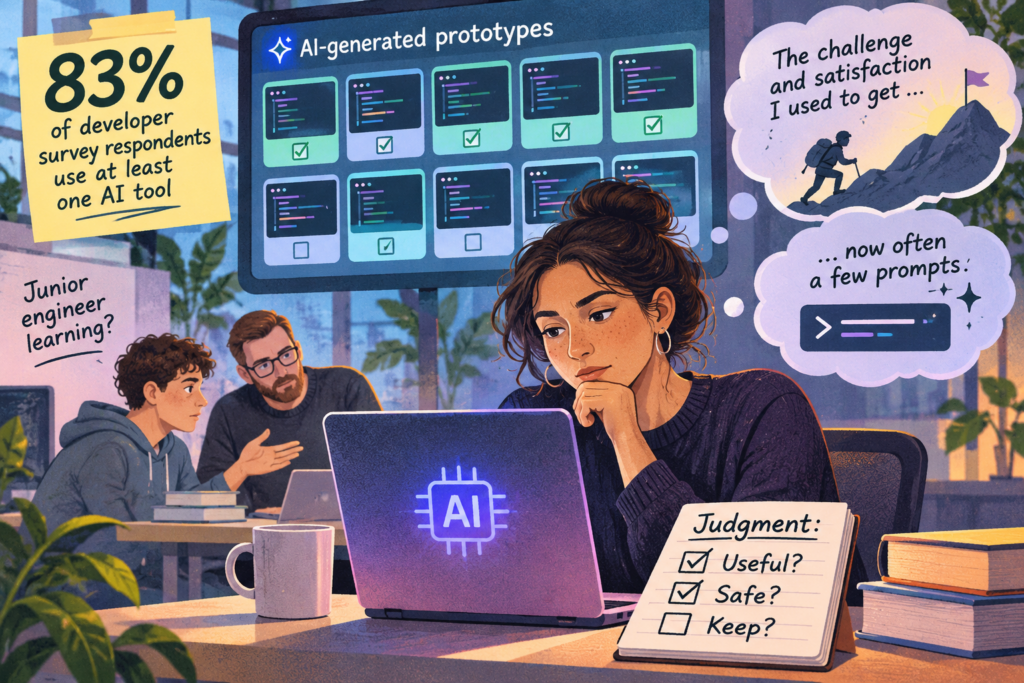
In interviews published on November 20, 2026, software engineers and technology executives described how AI coding tools were changing their work: developers could produce code and prototypes faster, but still had to decide what was useful and safe to keep. Some also worried that automating routine tasks could weaken the way new engineers learn.
The tools were already common among survey respondents. In Stack Overflow’s 2026 survey, 83% of software developers who responded said they used at least one AI tool.
James Broadhead, chief technology officer of AI decision-making company Taktile, said an engineer who once spent three weeks building a prototype could now generate 10 in an afternoon. The difficult part, he said, was judging which were any good. With AI agents producing so much code, engineers may no longer have read everything in a codebase they oversee.

For Gemma Rodgers, a self-employed developer in the U.K., the change has a personal cost. She said AI can turn a problem that once took days or weeks to solve into a few prompts, reducing some of the satisfaction she gets from working through a challenge. She also sees a benefit: AI can automate tedious parts of a project while she keeps the problem-solving she values.
Joshua Wöhle, CEO of AI training company Mindstone, said workers who use AI effectively could pull further ahead of those who do not. He characterized the loss felt by engineers who loved writing code as real, while arguing that companies may place less value on that work than they once did.
Chris Sees, a software engineer and CEO of virtual office company Hoxton Mix, sees AI as a capable junior engineer that needs supervision. He said developers must know what to delegate and when human judgment is required. But he also warned that routine coding and debugging have traditionally helped junior engineers build experience; companies need to make AI part of that learning process, not a shortcut around it.