The International Monetary Fund’s Article IV mission projected on 18 November 2026 that the United Arab Emirates’ economy would grow by 0.2% in 2026, reversing its forecast a month earlier of a 3.9% contraction. For 2027, the mission projected 7.3% growth, “assuming the regional disruptions are lifted.”
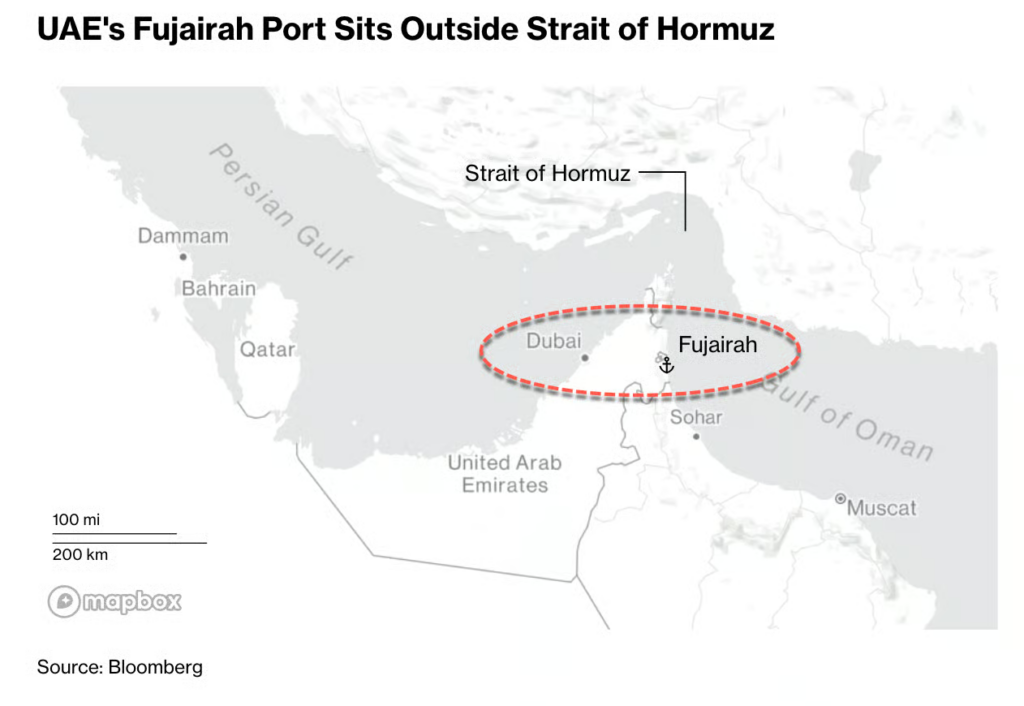
Oil production and non-oil trade help explain how the UAE has weathered the disruption so far. The condition on the 2027 forecast matters because the country can move only some of its oil around the Strait of Hormuz. In the week to 11 November, UK Maritime Trade Operations recorded 308 vessel crossings, about 65% below pre-war traffic.
Two forecasts point to nearly the same level of output
The World Bank’s October outlook projected a 1.6% contraction in 2026 followed by 9.5% growth in 2027 as regional conditions normalise. That rebound looks stronger than the IMF’s, but it starts from a lower base. Set inflation-adjusted GDP in 2025 at 100, and the World Bank’s forecast puts output at 107.75 in 2027. The IMF’s puts it at 107.51.
Neither path would make up all the ground lost relative to the UAE’s earlier pace. According to the World Bank, real GDP grew 4.3% in 2023, 6.6% in 2024 and 6.2% in 2025. Two more years at the average pace of about 5.7% would have put 2027 output 11.7% above its 2025 level, rather than the 7.5% implied by the IMF forecast. The difference is roughly $26 billion in 2025 prices. That is a comparison with a hypothetical growth path, not a measure of war damage.
The limits of the oil bypass
According to the World Bank, UAE oil output fell from 3.4 million barrels a day before the war with Iran began on 28 February to 1.9 million in March. It recovered to 3.8 million by June as shipments were rerouted, shipping conditions improved and the UAE gained production flexibility after leaving OPEC on 1 May. Non-oil trade rose 13.1% in the first half of 2026, with non-oil exports up 23.9%.
The Habshan–Fujairah pipeline can carry about 1.8 million barrels a day to a port outside the strait. The World Bank noted plans to double that capacity. Even if completed, the expansion would leave the bypass able to carry only 3.6 million barrels a day, well short of the UAE’s target of 5 million barrels a day of production capacity by 2027.
For cargoes that still pass through Hormuz, insurance remains a significant cost. War-risk premiums reached 7.5%–10% of a vessel’s hull value, up from 1%–3% previously, according to an S&P Global report cited by Al Jazeera.
Tourism and equities tell different stories
Economy and Tourism Minister Abdulla bin Touq Al Marri told CNBC after the IMF announcement that he was “very optimistic” about growth of 7%–8% in 2027. He said hotel occupancy was returning to “almost near normal.” The October figures still showed a substantial gap: Dubai hotel occupancy was 68.4%, down from 84.9% a year earlier, according to CoStar’s STR. Tourism contributed about $70 billion, nearly 12% of UAE GDP, in 2025.
Emirati stocks have not tracked that downturn closely. The US-listed iShares MSCI UAE ETF closed at $21.64 on 24 November, up 1.4% from $21.35 on 27 February, the last trading session before the war, according to iFind Flow closing prices.
The fund’s holdings help explain why its price is not a direct gauge of recovery. Its ten largest positions accounted for 74% of the portfolio at the latest disclosure, according to figures compiled by Composer. Banks represented about a third of the fund and property companies about 17%, while much of the airport, airline and hotel activity affected by the war sits outside the index. Vessel crossings, insurance premiums and hotel occupancy offer more direct measures of whether the disruption underlying the IMF’s forecast is easing.