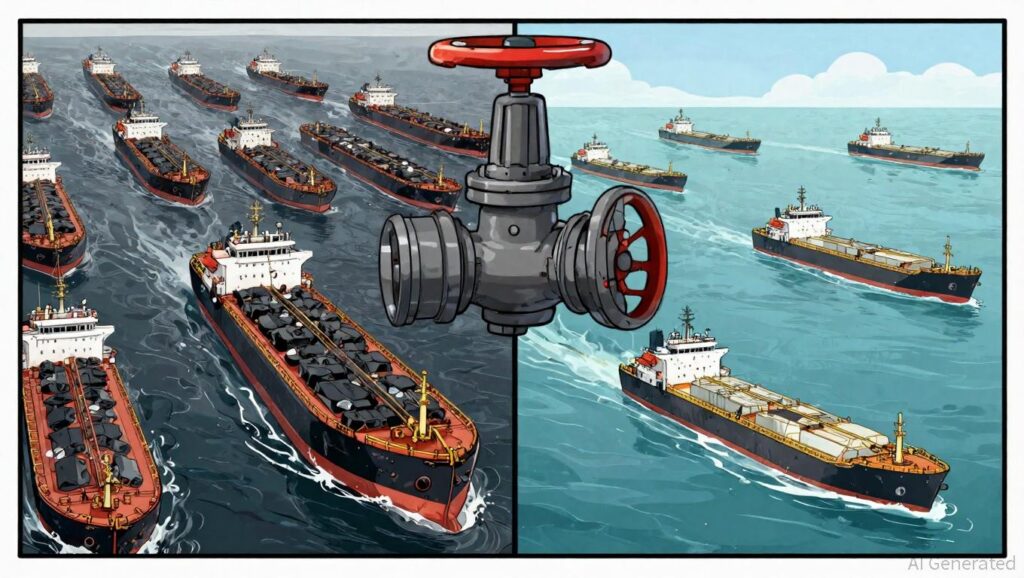
The LR2 tanker fleet tracked by Signal Ocean gained 59 ships between Jan. 1, 2025, and Oct. 30, 2026. Yet the number carrying refined fuels fell from 227 to 140, a 38% decline. By Oct. 30, 402 of the fleet’s 542 ships were hauling crude oil or heavy fuel oil. Their share had risen to 74.2% from 53.0% at the start of 2025.
The distinction matters for refiners booking a ship. Had the fleet maintained its January 2025 mix, about 255 LR2s would have been carrying refined products in late October 2026. The decision to put ships into other trades left 115 fewer than that, even as shipyards delivered new vessels.
Why owners switched cargoes
A Long Range 2 tanker, or LR2, is a vessel of roughly 110,000 deadweight tonnes. Its coated tanks can carry gasoline, diesel, jet fuel and naphtha — known as “clean” cargoes — but can also take crude and heavy fuel oil. An LR2 does not need a shipyard conversion to switch to those “dirty” trades. An Aframax crude tanker of similar size generally has uncoated tanks and cannot switch as readily to refined fuels.
In April 2026, the incentive to carry crude was roughly $71,000 a day on two benchmark routes. Gibson Shipbrokers put average earnings for fuel-efficient Aframaxes carrying crude from the U.S. Gulf to the U.K. and continental Europe at $153,250 a day, against $81,750 for LR2s carrying refined products from the Mediterranean to the Far East.
There were also fewer refined cargoes to collect. Gibson estimated that the Middle East war that began in late February disrupted Gulf refining and exports, removing about 2.4 million barrels a day of clean products from the tanker market. Ships shifted toward the Atlantic as U.S. crude exports and demand for long voyages rose. Smaller Medium Range tankers took on more of the refined-fuel trade, lifting 55% of clean cargo in October 2026, up from 48% in 2025.
Record freight rates did not reach every ship
With fewer large ships in clean service, S&P Global’s Platts clean tanker index for non-scrubber, non-eco vessels reached $121,198 a day on Sept. 30, its highest level since launch. But rates subsequently fell. On Nov. 23, Gibson reported that LR2 earnings on the Mediterranean-to-Far East route had dropped to $60,000 a day from $175,000 in mid-October.
Scorpio Tankers attributed its strong fourth-quarter bookings to “tight LR2 supply as larger vessels remained employed in crude trades.” It reported that 44% of its expected fourth-quarter LR2 revenue days were booked at $181,000 a day in the pool and spot market. Its LR2s on time charters, by contrast, earned $32,150 a day. The implied blended rate was roughly $98,000 a day — well above the third-quarter average of $55,184, but not the $181,000 spot and pool figure. Neither booking figure was a final result for the quarter.
What a return to refined fuels would change
Of the 402 LR2s carrying crude or heavy fuel oil on Oct. 30, just 40 would have to switch back to increase the number in clean service by about 29%. That calculation illustrates the scale of the potential change, not a forecast of when owners will make it. Gibson and Signal Ocean both noted that cleaning tanks for a return to refined products takes time and money. Gibson also pointed out that damage to Gulf refineries could limit the supply of cargoes even if transit through the Strait of Hormuz normalizes.
Another 82 LR2s and 163 Medium Range tankers were scheduled for delivery through 2027, after 73 LR2s and 116 Medium Range vessels had already been delivered in 2026. For refiners and tanker operators, those deliveries tell only part of the story. The weekly count of LR2s actually carrying clean products fell for five consecutive weeks in October. A sustained rise in that count would be a more direct sign that ships were becoming available to move refined fuels again.