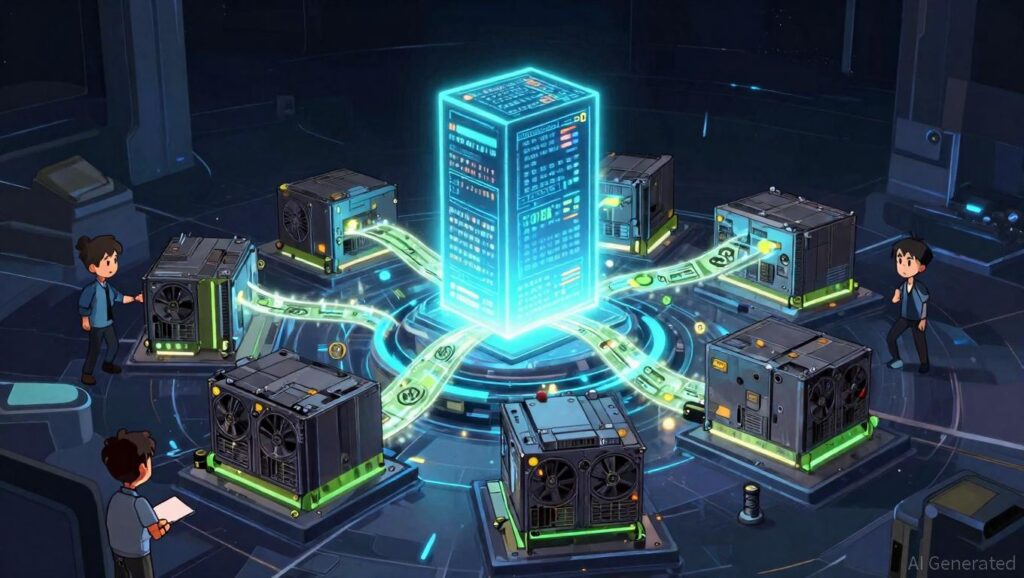
Flop Labs said more than 50 miners came online within hours of its November 26, 2026, testnet opening to GPU owners. Their hardware ranged from Nvidia’s RTX 3090 consumer card to its H200 and B300 data-center accelerators. The company said the network was ready to serve requests, but its announcement disclosed neither total computing capacity nor the volume of settled transactions. The count shows that suppliers signed up, not that customers bought computing time.
Flop Labs, led by BitMEX co-founder Arthur Hayes, is building a blockchain on which AI agents can buy inference: the work of running a model to answer a request. Miners supply the computing power and submit proof of the work; validators record the proofs. Testnet participation can qualify operators for FLOP tokens, but the tokens are not due to be created until the live network launches. The company is targeting the first quarter of 2027 and has not announced an exchange listing.
What an H100 could earn
In Flop Labs’ model, an Nvidia H100 running the gpt-oss-120b model at full utilization generates about $1,750 a month in inference fees. That calculation assumes prices of $0.20 per million output tokens and $0.04 per million input tokens. At the initial 99% miner share, the operator would keep about $1,733. Against the company’s assumed monthly H100 rental cost of $2,153, that leaves a $420 shortfall even at full utilization, before other operating costs.
Newly issued tokens change the calculation. The planned initial reward is 96 FLOP per block, with 75% going to miners. That gives miners a fixed pool of about 186.6 million FLOP a month, divided according to verified work. An operator earns no premium per unit of work for using a more expensive GPU.
Flop Labs’ first-month scenario assumes a $100 million network value and capacity equivalent to 1,200 H100s. At the implied price of about $0.22 per FLOP, the monthly miner pool would be worth roughly $41 million, or $34,000 per H100-equivalent — about 16 times the assumed rental cost. That is a modeled reward, not observed revenue or a quoted token price. If the price held and all capacity were rented at that rate, the reward per H100-equivalent would fall to the rental cost at roughly 19,000 H100-equivalents. The reported miner count does not establish how close the network is to either capacity figure.
Claims are not purchases
Flop Labs reported about 70,000 cumulative agent claims by the testnet’s second day. That was not a count of distinct agents or completed jobs. Claiming test tokens alone earns no allocation: only purchases in settled sessions count, and the rules exclude payments to a miner controlled by the same operator. The first testnet inference was still on the team’s task list in its day-two update. The testnet opened without scoring, and the team had not yet announced the block at which activity would begin counting toward allocations.
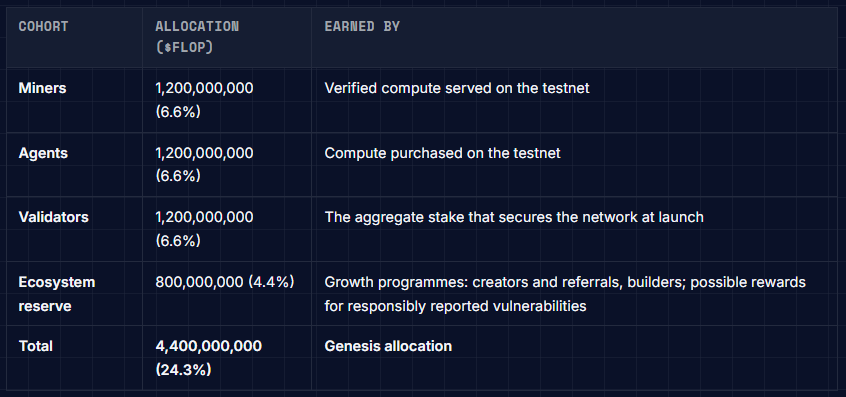
Even settled transactions would initially reflect an incentive for buyers. Of the 4.4 billion tokens planned at launch, the terms earmark up to 1.2 billion each for agents, miners and validators, with 800 million for an ecosystem reserve. Under the agent terms, three-quarters of the allocation goes toward inference purchases and one-quarter unlocks as liquid tokens. Using the full allocation would therefore require 900 million FLOP of purchases, worth about $196 million at the planning price. The company’s base case spreads that spending over roughly three years. Whether agents keep buying afterward is a separate test of demand.
Network value and token price can diverge
Flop Labs projects that 460 million FLOP will circulate at launch, with the rest of the initial supply locked. Block rewards and a separate developer subsidy would add about 3.53 billion new tokens a year in the first reward period. By the first scheduled halving, 730 days after launch, the company projects about 9.6 billion tokens in circulation — roughly 21 times the initial amount.
Even in the company’s base case, where network value rises 15-fold to $1.5 billion, the implied price at that point is about 28% below the initial $0.22 planning price. The whitepaper says the protocol charges no platform fee and burns no tokens; fees go almost entirely to miners and validators.
For now, the figures that would connect the launch to a business are fees paid by independent agents and how those fees compare with both miner rewards and the cost of supplying compute. Flop Labs’ November 26 announcement showed that GPU owners were willing to participate on the offered terms. It did not establish how much buyers were willing to pay.