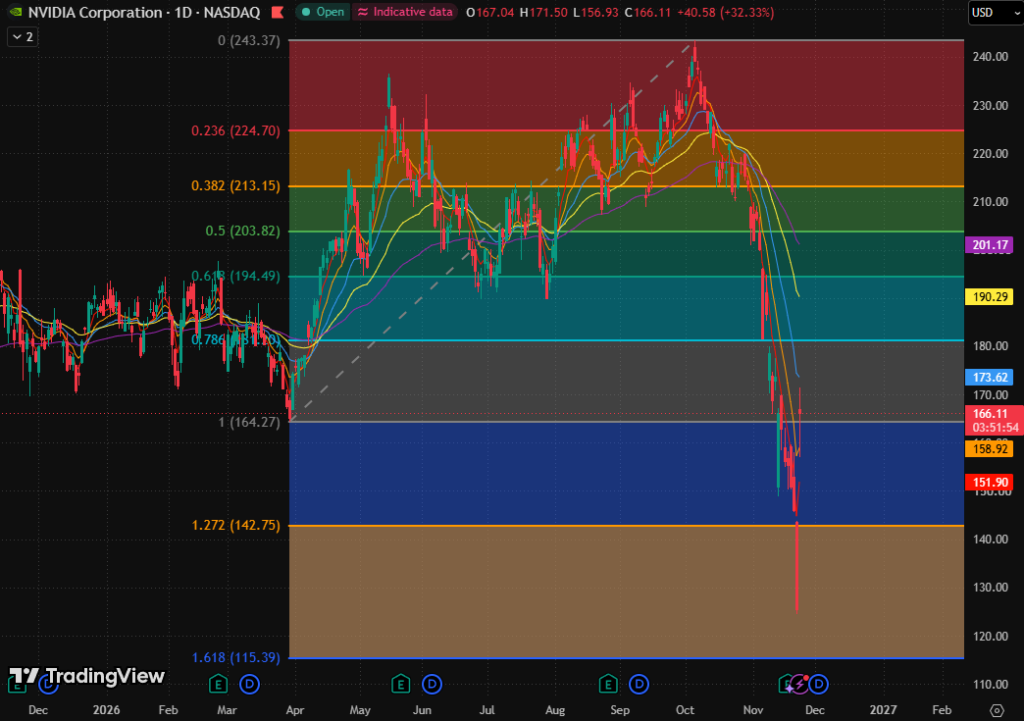
Nvidia expects $130 billion in fiscal fourth-quarter revenue, give or take 3%, without counting any sales of data-center computing chips to China. When Chief Executive Jensen Huang is scheduled to testify before the Senate Banking Committee on Dec. 3, 2026, the broader question will be how U.S. export controls affect Nvidia’s sales to data centers elsewhere that rent computing power to Chinese firms.
Where the licensing rule applies
An interim rule published Nov. 16 by the Commerce Department’s Bureau of Industry and Security requires a data center anywhere in the world to obtain a license before receiving advanced U.S. chips if it rents large amounts of computing power to Chinese firms. The rule also adds licensing requirements for shipments to Singapore, Malaysia, Indonesia, Thailand and Brazil. Data centers already serving the affected customers have 90 days to apply, a window that runs into mid-February 2027.
Jefferies estimates the rule could reduce Nvidia’s data-center revenue by $44 billion to $62 billion in 2027. For comparison, Nvidia recorded $2.4 billion in licensed sales of Hopper data-center chips to China, including the H200, in the fiscal third quarter ended Oct. 25. That was 2.2% of its $107.6 billion in quarterly data-center revenue. Colette Kress, then interim chief executive, told analysts Nvidia was no longer shipping those products to China.
Nvidia disputes the projected impact. On its Nov. 17 earnings call, management raised its fiscal 2028 growth outlook from 70% to about 75%, saying it had already accounted for the controls. Kress said demand from buyers on the waiting list was sufficient to keep total revenue from falling as a result of the rule.
What the Senate hearing could clarify
The board reinstated Huang on Nov. 23, saying it had concluded that his return posed no national-security risk. Nvidia shares rose 31.48% that day, adding nearly $1 trillion in market value. By Nov. 27, the stock traded near $150, about 38% below its October high of $243.37.
Two news reports have raised questions about how advanced chips reach their end users. Bloomberg reported on Nov. 27 that a GB300 NVL72 system had been installed in a Shanghai data center. It cited a serial number in filings for a 96 million yuan ($14 million) loan for which a Shanghai firm pledged the hardware as collateral. Shipping that system to China requires a U.S. license. Gigabyte, which assembled it, declined to identify the buyer. Separately, CBS News reported on Nov. 25 that Nvidia had sold advanced chips to at least two California-registered companies with Chinese-owned parents, one of them an Nvidia preferred partner.
Neither report establishes that Nvidia violated export controls. Senator Elizabeth Warren said Huang’s return increased the urgency of passing bipartisan export-control bills. President Donald Trump said the attorney general had found no evidence of unlawful conduct and urged Nvidia to continue its internal investigation. If senators conclude that customer screening is inadequate, they could seek additional conditions on sales outside China. Such conditions are a possible outcome, not a requirement of the hearing.
The financial test for Nvidia
Nvidia reported fiscal third-quarter revenue of $115.8 billion, up 103% from a year earlier. The $130 billion midpoint of its next forecast implies a 12.3% sequential increase, but the fourth quarter has 14 weeks rather than 13. On a weekly basis, the midpoint is $9.29 billion, up about 4.2% from $8.91 billion. Nvidia also expects gross margin of 71% to 72%, down from 74.8%. Together, weekly sales and margin will help show whether other buyers are replacing restricted demand on comparable terms.
The stakes extend beyond one quarter. Nvidia disclosed $390 billion in supply and capacity purchase commitments, up $111 billion in three months, mostly because of multiyear memory purchases. It also reported $118 billion in guarantees, including up to $105 billion in credit support for land, power and buildings at an Ohio campus used by OpenAI under a 20-year lease. Receivables rose about $18 billion, and the average collection period increased from 60 to 64 days.
If buyers absorb the available chips, the purchase commitments help Nvidia secure scarce supply. UBS warned of a different possibility: those commitments could leave Nvidia having to finance customers to sustain sales. The distinction matters because finding another buyer for a chip is not the same as finding one that can pay on the same terms.