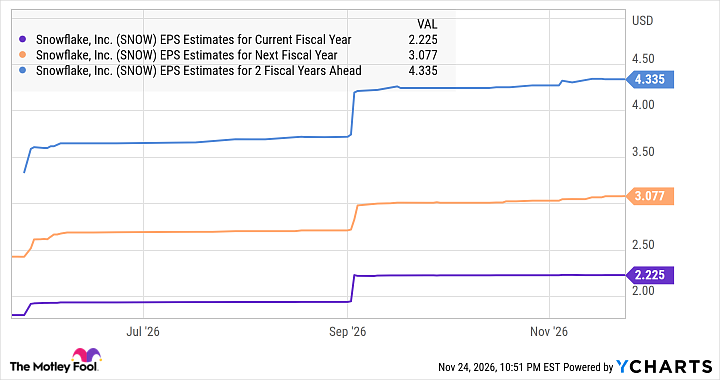
Snowflake expects product revenue to grow 37% to 38% for the three months ended in October. When the cloud data company reports after the market closes on Dec. 2, 2026, investors will also see how much of that revenue it kept after paying to run the service. Analysts’ estimates imply a non-GAAP product gross margin of about 73.6%, down from 74.7% in the previous quarter.
In September, Snowflake raised its full-year product revenue forecast from $5.84 billion to $6.07 billion while cutting its non-GAAP product gross margin forecast from 75% to 74%. Chief Financial Officer Brian Robins said fast-growing AI workloads “carry a lower contribution margin today.”
Why the second-half margin matters
Snowflake charges customers for the computing power and storage they consume. In the previous quarter, product revenue reached $1.49 billion, or 96% of total revenue. Net revenue retention was 126%, meaning customers on the platform a year earlier spent 26% more as a group. More than 9,100 accounts used Snowflake’s CoCo coding agent, an increase of more than 2,000 during the quarter.
Snowflake earned $2.12 billion in non-GAAP product gross profit on $2.83 billion in first-half product revenue, a 74.9% margin. Its full-year guidance implies a second-half margin of roughly 73.2%, about 1.7 percentage points lower. That is an estimate derived from the annual outlook, not a separate company target for the October quarter. At the projected $6.07 billion in annual product revenue, one percentage point of margin represents about $61 million in gross profit.
What to compare on Dec. 2
The consensus product revenue estimate of $1.59 billion falls within management’s $1.588 billion to $1.593 billion range. The higher consensus estimate of $1.65 billion in total revenue includes about $57 million from professional services. On the product side, analysts expect $1.17 billion in non-GAAP gross profit, the basis for the 73.6% margin estimate.
A product gross margin near the previous quarter’s 74.7% would suggest the pressure from the changing mix of workloads had eased, at least for the quarter. A result below about 73% would make management’s explanation of costs and its full-year outlook more important. The margin alone cannot establish how profitable AI usage is.
Operating margin is a separate measure. Snowflake guided to a 15.5% non-GAAP operating margin, up from 15.3% in the previous quarter. On a GAAP basis, the company still reported an operating loss that quarter, though its operating margin improved to negative 17% from negative 30% a year earlier.
A smaller valuation premium
Snowflake shares closed at $273.31 on Nov. 27, 29% below their Sept. 3 intraday high of $384.56. Citi, KeyBanc and Bank of America cut their price targets but kept their Buy or Overweight ratings, citing lower valuations across software rather than weaker expectations for Snowflake.
At the Nov. 27 price, Snowflake’s enterprise value was about $94 billion after accounting for roughly $2 billion in net cash. That put the company at about 15.5 times its full-year product revenue forecast, down from roughly 22 times at the September peak. On a comparable trailing-sales basis, however, Snowflake still traded at about 17 times revenue, against 12.9 times for Datadog and 8.4 times for MongoDB, according to AInvest market data. The Dec. 2 results will help show how much gross profit Snowflake’s faster growth is producing.