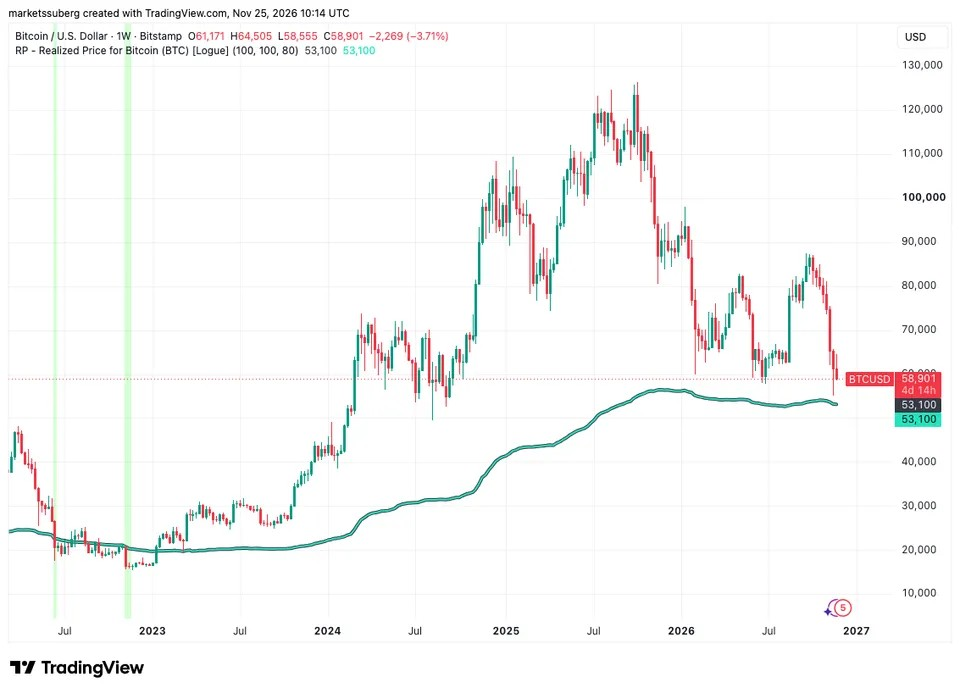
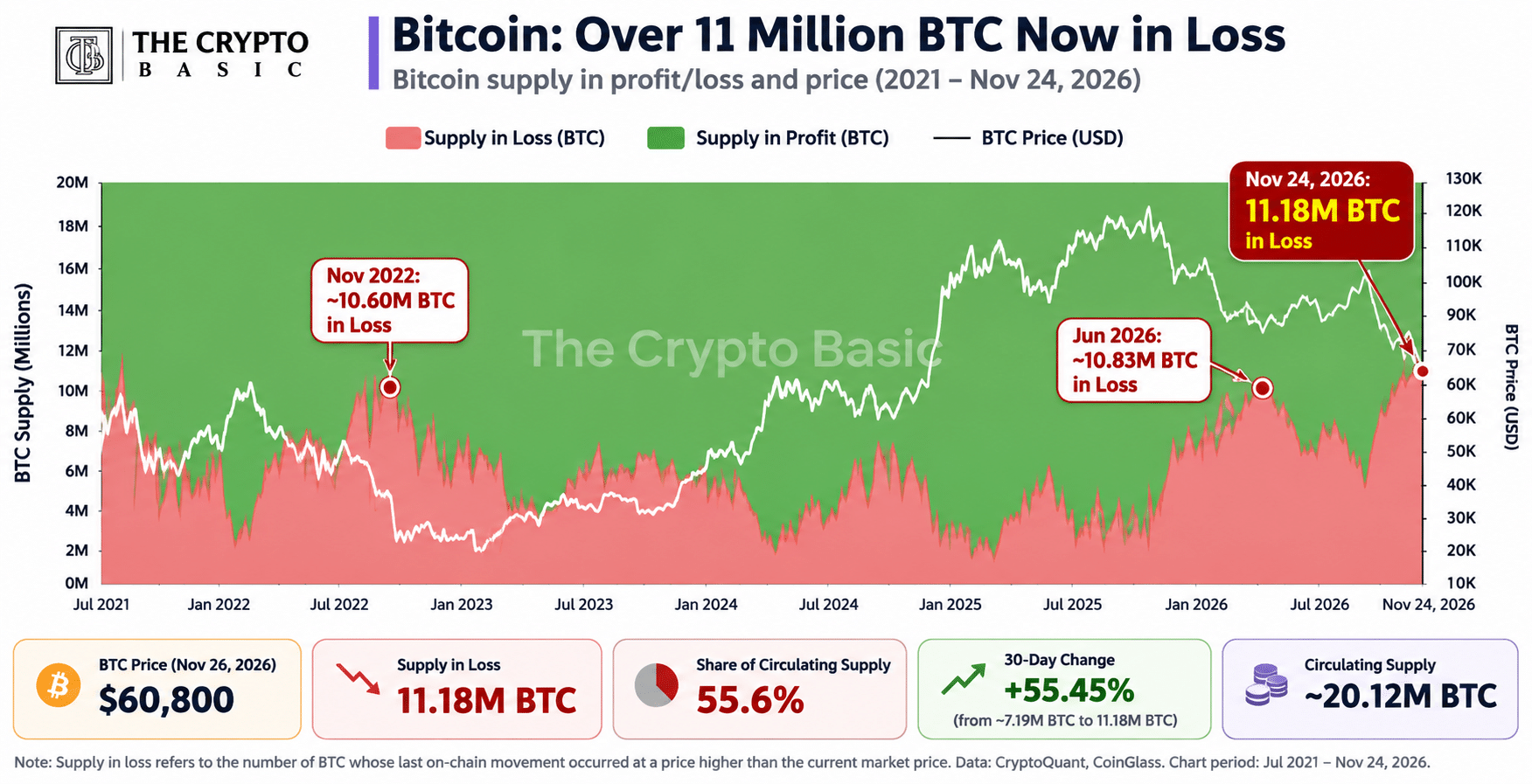
Bitcoin closed at $59,857 on November 27, 2026, down 26% in a month. The next day, BeInCrypto noted that net unrealized profit and loss (NUPL) had fallen to roughly 10%, a level that held in February and June. Yet CoinGlass counted 11.18 million bitcoin at a loss on November 24, or 55.6% of the circulating supply. The figures measure different things: one captures the size of gains and losses across the market; the other counts coins.
Why the average coin was still in profit
NUPL compares Bitcoin’s market value with its realized capitalization, which values each coin at the price when it last moved on-chain. The difference, divided by market value, is NUPL. A 10% reading means the market price is about 11% above the realized price, the average price at which coins last moved. Glassnode put the realized price at $53,200 on November 25, when bitcoin traded at $58,919.
The 8.94 million coins still in profit on November 24 were mostly older coins that had last moved at much lower prices. Their gains were large enough to outweigh losses on the rest of the supply. Recent buyers faced a different calculation: CryptoQuant estimated on November 19 that coins held for one to three months had an average cost of $81,521. At $60,000, that group was down roughly 26%.
The distribution of costs also helps explain why a recovery toward $64,000 could encounter selling. About 1.22 million bitcoin, or 6% of supply, last moved between $63,111 and $64,373. A rally into that range gives those holders a chance to sell near break-even, though the balances alone cannot establish that they sold. On November 23, bitcoin reached $64,673 before closing near $61,300.
What $53,200 can tell investors about a bottom
At the realized price, gains and losses offset each other across the market and NUPL reaches zero. Glassnode found that bitcoin traded below its realized price before the bottom of each of the four completed bear markets. It stayed below that benchmark for as long as 301 days, including a stretch of 180 days in 2022. The benchmark itself can fall as coins change hands at lower prices.
That history offers little guidance on timing. In a study of 5,907 daily closes since 2010, Phemex found a median return of 4.0% over the next 30 sessions after NUPL fell below zero, compared with 3.1% after a randomly selected day.
Galaxy Research found that the decline had lasted 414 days, longer than the 163 to 406 days recorded in the previous four bear markets. But the price had fallen 53% from its peak, less than the 77% to 93% declines in those cycles. The $53,200 realized price therefore answers a narrower question than when the market will turn: it shows where the average coin would break even, not where buyers will stop the decline.