As reported on November 23, 2026, Brazilian crop trader Amaggi was switching its Madeira River barges to 100% biodiesel. The company produces biodiesel from soybean oil, giving it a different fuel-cost calculation from a buyer that must purchase and transport the finished fuel.
“We’re using biodiesel because, first, we trust it. Second, today it makes economic sense,” Ricardo Tomczyk, Amaggi’s director of institutional relations, said in an interview. The barges carry crops to the company’s export terminal at Itacoatiara on the Amazon. Amaggi was also studying a switch for part of its trucking fleet.
A price gap, but not a like-for-like comparison
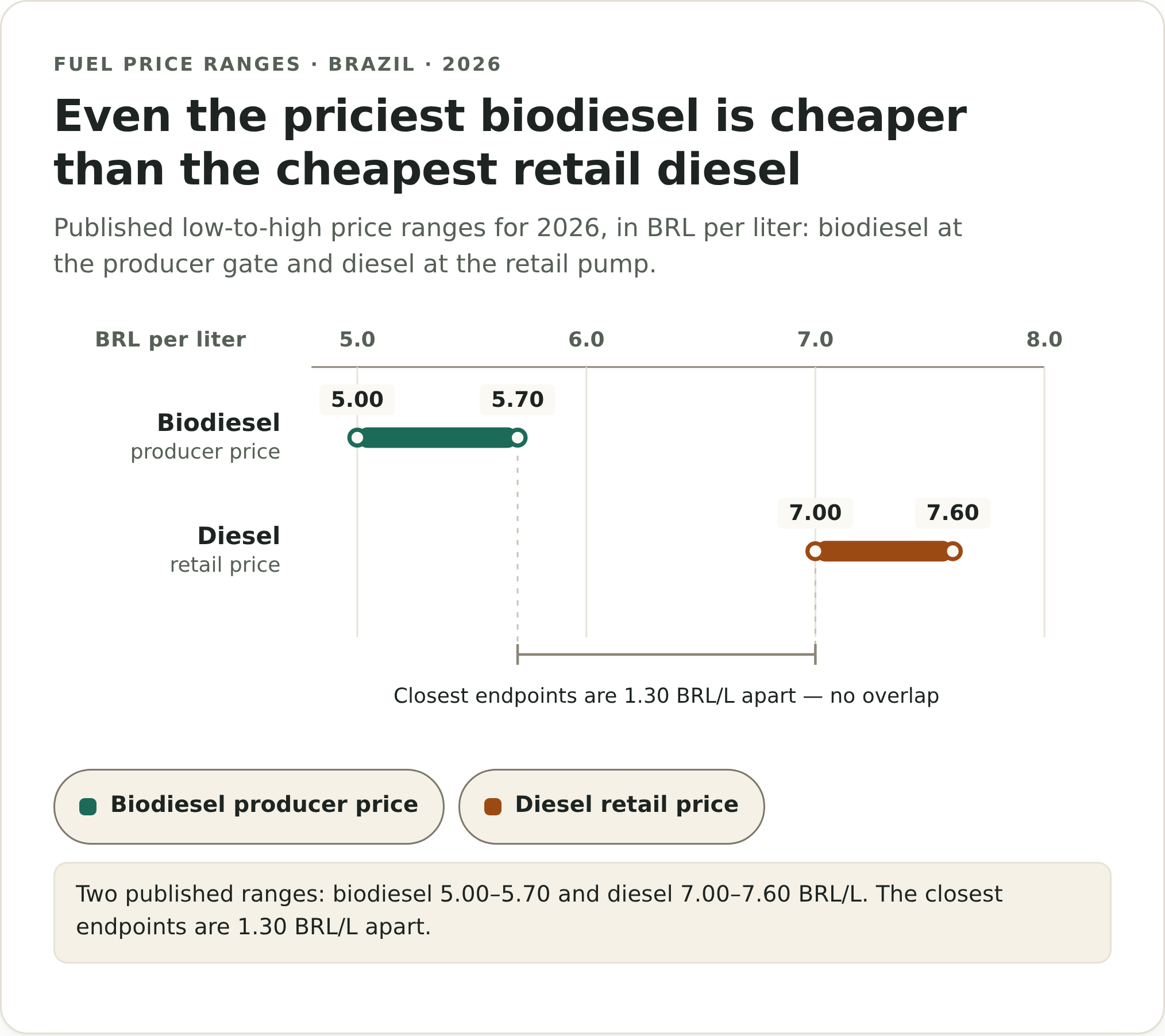
Rystad Energy data cited in the report put Brazil’s 2026 biodiesel producer price at 5–5.70 reais per liter, compared with about 7–7.60 reais per liter for retail diesel. At the midpoints, biodiesel is roughly 27% cheaper. But the figures measure prices at different points in the supply chain: a producer-gate price versus a retail pump price. They do not establish the fuel savings available to every fleet operator.
Amaggi can use fuel it produces and has its own storage at some farms. Rystad senior bioenergy analyst Thiago Sinzato said the price difference is particularly attractive for agricultural operations with their own fueling infrastructure. A buyer paying for biodiesel distribution may face a narrower gap.
Brazilian policy also affects both sides of the comparison. The country imports about 33% of the diesel it consumes. A diesel import subsidy had ended earlier in November, while the government had extended a separate diesel subsidy worth 2.12 reais per liter in late September. Diesel’s retail price is therefore not an unchanging benchmark.

The soybean-oil trade-off
Brazil’s required biodiesel blend remained at 15% in 2026 after a proposed increase was not approved. The National Supply Company, Conab, assumes a rise to 16% in 2027; that is a forecast assumption, not an enacted change.
In its November crop survey, Conab cut its forecast for domestic soybean-oil consumption by 440,000 metric tons to 11.19 million tons because the blend stayed at 15%. It raised its export forecast by 400,000 tons to 1.8 million tons. The agency projected 2026–27 soybean-oil production of 12.84 million tons and ending stocks of 587,500 tons.
Conab said an assumed move to a 16% blend, alongside lower projected stocks, could support domestic soybean-oil prices and restrict export availability later in 2027. If the requirement instead stays at 15%, that additional fuel demand would not arise from a higher mandate.
Amaggi is closely held, so its barge-fuel savings are not a direct public-market exposure. Listed processors such as Bunge and ADM are exposed more broadly to soybean-oil supply, crushing margins and biofuel demand. The immediate lesson from Amaggi’s switch is narrower: biodiesel can make economic sense for a producer using its own fuel, but the quoted producer-versus-retail price gap is not a universal fuel-cost comparison.