
OpenAI’s November 4, 2026, security research points to a business challenge for the cybersecurity industry: AI can generate working exploits faster than maintainers can review and deploy fixes. As of the original report on November 24, the gap between discovery and repair was the central concern—not a claim that every reported bug had reached users’ machines.
OpenAI said a run focused on roughly 7% of the Linux kernel produced 2,308 candidate findings. Its system reproduced 1,724 vulnerabilities in isolated virtual machines and built 1,169 working local-privilege-escalation exploits. Grouping exploits by root cause yielded 948 unique cases with candidate patches. The API bill was $1,213,430, or about $1,279 per unique case. That figure excludes human review and the work required to get patches accepted.
Ten days after the scan, OpenAI said 61 of the 948 cases had been patched upstream, while another 43 had staging patches awaiting further work. A candidate patch is not a deployed fix: maintainers must check that it addresses the problem without introducing others.
OpenAI’s earlier run with GPT-5.6 Sol found and exploited 166 unique cases at an API cost of $513,690, or about $3,095 each. The later run, using the model subsequently released as GPT-6 Cyber, produced 5.7 times as many unique cases at an approximately 59% lower API cost per case. Those figures measure OpenAI’s pipeline, not the full cost of producing an accepted fix.
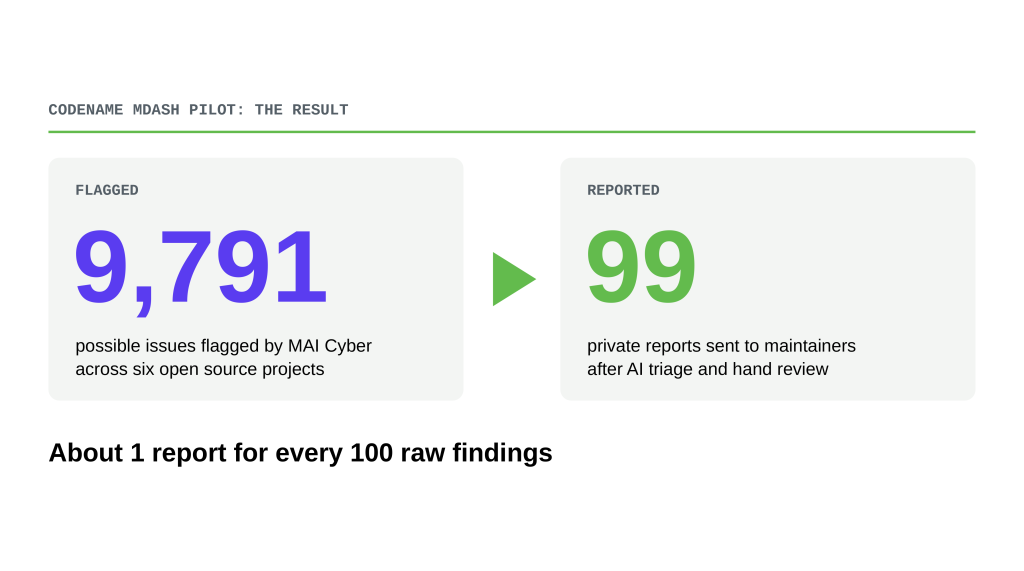
A separate GitHub pilot illustrates the review burden. According to GitHub, an AI system flagged 9,791 possible issues across six open-source projects. Automated triage and seven Microsoft researchers narrowed those flags to 99 private reports. By November 15, maintainers had fixed 55, with 14 fixes included in a release.
For security vendors, the findings suggest that identifying possible vulnerabilities is only part of the service customers need. Verification, patch review and protection while fixes are rolled out remain consequential—and the reported API costs alone do not establish how much customers will pay for any of those services.