On Monday, November 23, 2026, the S&P 500 closed at 7,237, up 4.73% from Friday, November 20’s close of 6,910. Nvidia rose 31%. Morgan Stanley strategist Mike Wilson’s note, circulated at midnight Monday, had addressed Friday’s close, which remained below the 7,100-to-7,300 zone he had previously identified as where the correction would end. His 12-month target for the index is 8,700.
The target is constructed as 19 times Morgan Stanley’s 2028 estimate of S&P 500 earnings of $458 a share. Nineteen times $458 is $8,702. At Monday’s close, that same $458 figure implied a multiple of 15.8 times. Reaching the target therefore requires the market to reprice those earnings at 19 times if the estimate holds.
Coverage of the call has often emphasized Wilson’s forecast of 14% earnings growth in 2027. The consensus estimate is 17%. Morgan Stanley calculates that the market is already pricing about a 6% decline in 2027 earnings, roughly 20 percentage points below the bank’s own forecast. The divergence is in the multiple, not in a more aggressive earnings outlook than the Street’s.
At Friday’s 6,910 close, the S&P 500 traded at 16.4 times the next twelve months’ earnings of about $421 a share, the multiple Morgan Stanley cited. Monday’s rally raised that multiple to roughly 17.2 times. From Monday’s level, the path to 19 times the $458 estimate is about 9% earnings growth from $421 to $458 and about 10% multiple expansion from 17.2 to 19. Measured from Friday’s close, the multiple component was about 16%. The single 4.7% session removed roughly one-third of that re-rating.
At 19 times earnings, the index earnings yield is 5.26%. The 10-year Treasury closed Monday at 4.92%, leaving a gap of about one-third of a percentage point. The gap was about 0.9 points at 17.2 times and about 1.2 points at 16.4 times. The target implies surrendering most of the remaining spread of equities over government bonds. Traders priced roughly a 90% chance of a quarter-point rate increase on December 9. New York Fed President John Williams said Monday that he expects inflation to end the year at 3.5% and to moderate to just above 2% next year. Wilson described market pricing as “far too hawkish versus the eventual Fed path.” The 19-times assumption requires the Federal Reserve’s path to be easier than markets currently discount.
The $458 estimate is linked to capital spending. Morgan Stanley’s analysts project AI capital expenditure of $1.6 trillion in 2027 and $1.8 trillion in 2028, up from more than $800 billion in 2026. Trailing-twelve-month figures through the latest reported quarter, drawn from Ainvest market data, show:
| Company | Capital spending | Operating cash flow | Free cash flow |
|---|---|---|---|
| Microsoft | $135.9B | $195.9B | $60.0B |
| Amazon | $215.2B | $168.3B | -$46.9B |
| Alphabet | $159.8B | $179.6B | $19.8B |
| Meta | $106.9B | $133.1B | $26.2B |
| Total | $617.8B | $676.9B | $59.1B |
Across the four companies, capital spending equals 91% of operating cash flow. Free cash flow fell 23% at Microsoft, 73% at Alphabet and 42% at Meta over the past year, and turned negative at Amazon.
Nvidia’s latest 10-Q reports that three direct customers accounted for 16%, 15% and 13% of first-half revenue, or 44% combined. The filing does not name the customers. Those buyers’ capital outlays are the seller’s revenue, and the buyers are producing less free cash flow. Bloomberg reported that CoreWeave plans a $4 billion investment-grade term loan at 7% to 7.5% to help fund $37 billion to $39 billion of 2026 capital spending. Its unsecured bonds have yielded above 16%, and total debt stands at $46.9 billion against $7.5 billion of quarterly cash burn.
The interest rate that helps set the equity multiple also sets the financing cost of the spending expected to produce the earnings. A higher 10-year yield lowers the price investors will pay for $458 of earnings and raises the cost of funding the projected spending. The earnings estimate and the multiple are not separate assumptions.
Concentration shapes what must be repriced. The top 10 stocks represented 39.96% of S&P 500 market value in October. Ainvest data show an equal-weight S&P 500 fund 5.1% below its 52-week high and a Nasdaq-100 fund 14.7% below its high. Nvidia’s 31% gain added about $950 billion of market value and roughly one-third of the S&P 500’s 4.7% rise, because the stock began the session at about 5% of the index. If the top 10 companies generate roughly a quarter to a third of index profits, a 20% earnings reduction at those firms would subtract five to seven points from index earnings—near the decline Morgan Stanley says is already priced—while the remaining companies could be unchanged.
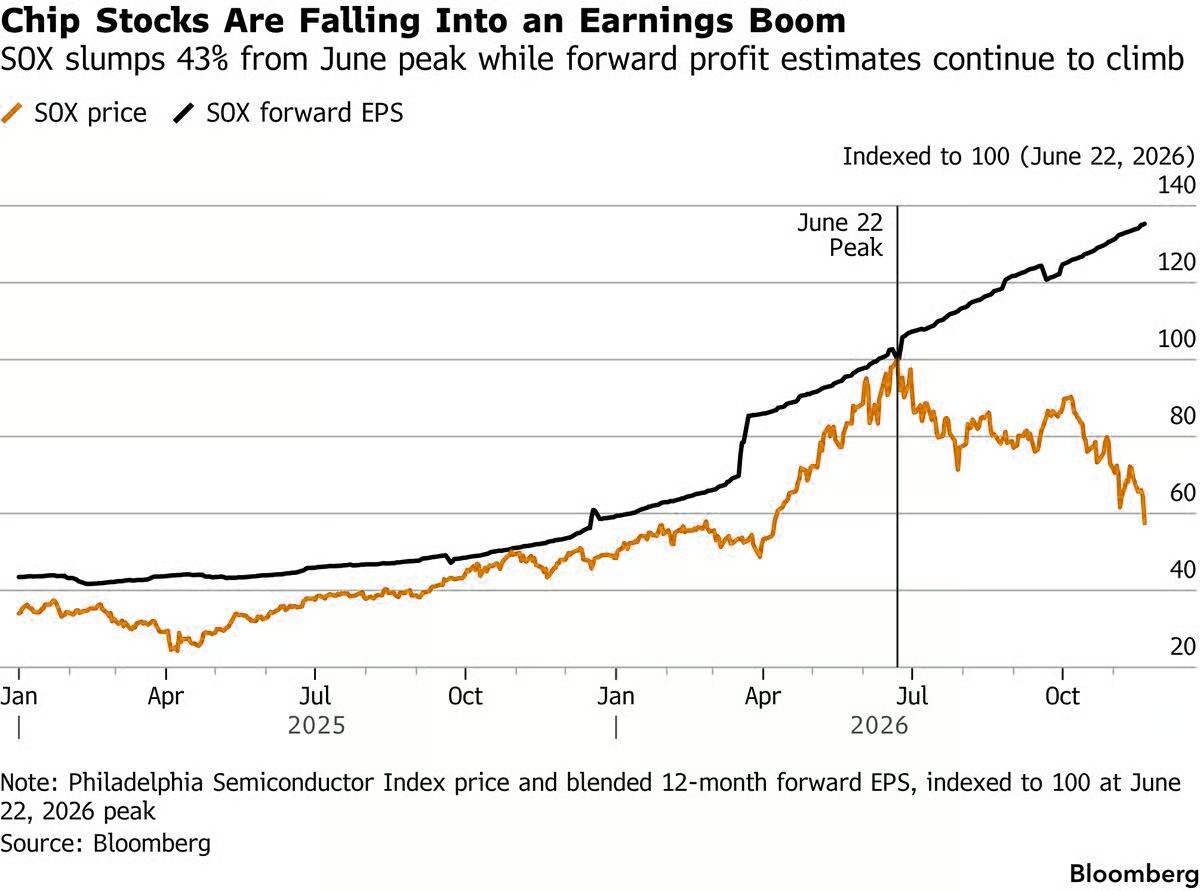
The Philadelphia Semiconductor Index is down 43% from its June 22, 2026 peak even as forward profit estimates have continued to rise. Prices have declined because investors are paying a lower multiple for those estimates, not because the estimates themselves are being cut. The adjustment can stop if rates ease and can extend if they do not.
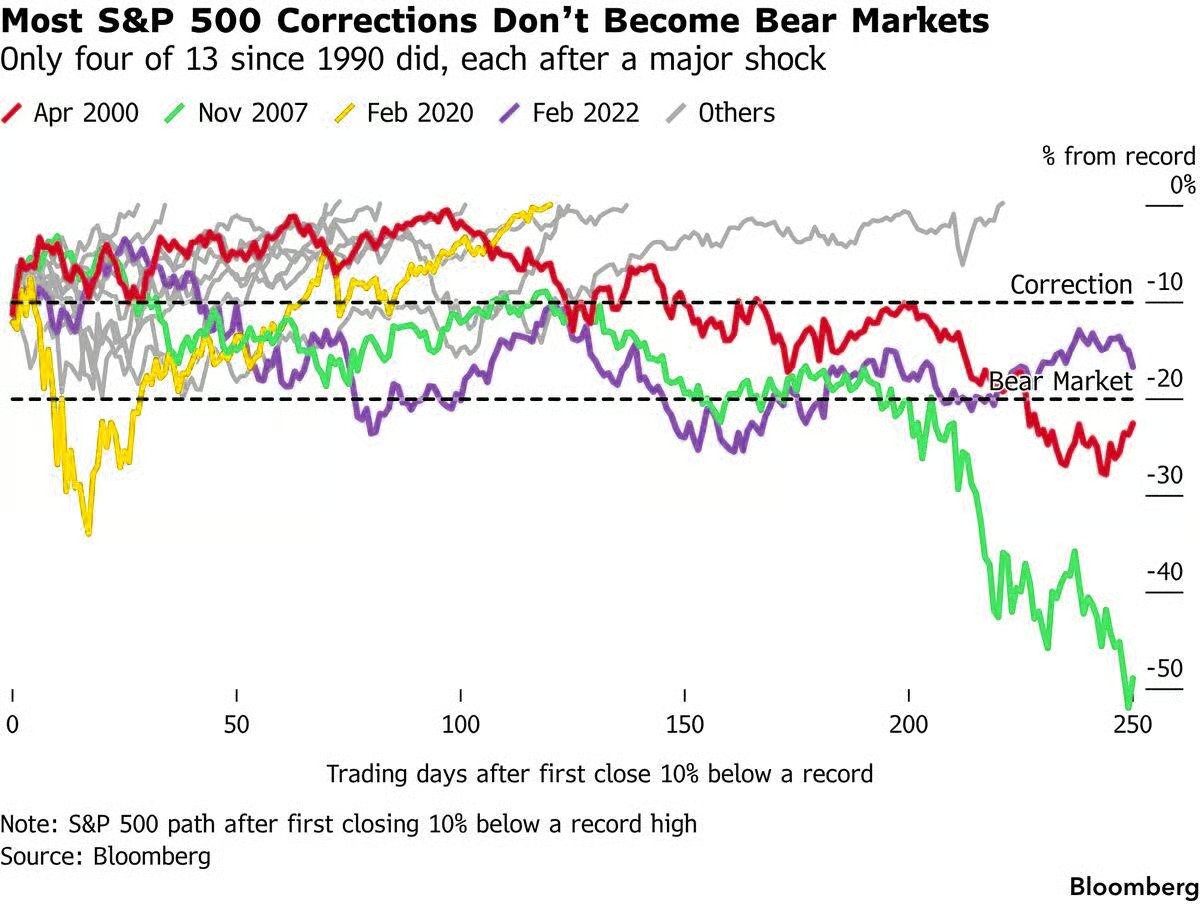
The cautious case is a capital-spending and valuation argument rather than a recession forecast. Earnings were still growing in a strong third quarter, and credit markets remain open enough for CoreWeave to seek borrowing at 7% to 7.5% secured by GPUs and contracts. Positioning had been reduced: the VIX was near 40, and hedge-fund net leverage had fallen to the first percentile of its one-year range. Bloomberg data show that only four of 13 S&P 500 corrections since 1990 became bear markets, each after a major shock. Whether an interruption in AI capital spending together with further Federal Reserve tightening would qualify as that kind of shock is not settled by the historical count.
Three subsequent readings are directly relevant. First is the December 9 Fed decision and the 10-year yield. A quarter-point increase is nearly fully priced; the path afterward is not. A move in the 10-year toward 4.5% with a signal of a pause would make 19 times easier to defend. A yield remaining near 5% with projections of additional hikes would leave the multiple at odds with the bond market. Second is hyperscalers’ fourth-quarter capital-expenditure guidance, expected in late January and early February, and whether 2027 spending supports the near-doubling Morgan Stanley assumes. A lower guide would affect the $458 estimate before the multiple. Third is the pricing of CoreWeave’s $4 billion secured loan. Clearing at 7% to 7.5% would indicate the financing channel is holding; a withdrawn or materially wider deal would point to strain.
The equal-weight S&P 500 is a practical comparison. If it keeps pace with the capitalization-weighted index, the rebound is broadening. If the cap-weighted index continues to lead while equal weight lags, higher prices are concentrated in the largest stocks, and 8,700 is chiefly a statement about the multiple on those names.
Wilson’s target is arithmetically consistent, and his earnings figure is not higher than the consensus. The distinctive element is the 19-times multiple alongside a 4.92% 10-year Treasury yield. The 8,700 level is a forecast that the Fed’s path eases relative to current pricing and that investors will pay 19 times for earnings that the projected AI spending boom has still to deliver. Monday’s 4.7% advance already absorbed roughly one-third of the re-rating embedded in that target.