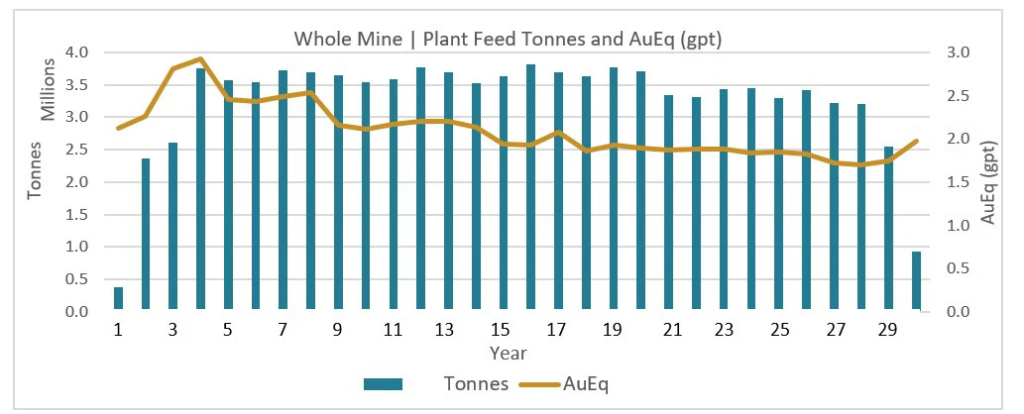
Tudor Gold’s first preliminary economic assessment for Treaty Creek in British Columbia estimates that an underground mine could produce 4.68 million ounces of gold over 28 years. The study, released on November 24, 2026, puts the whole project’s after-tax net present value at US$2.3 billion. Reaching production would require US$1.54 billion, or about C$2.20 billion at the study’s exchange rate—roughly nine times Tudor’s C$240 million stock market value that afternoon.
Tudor owns 80% of Treaty Creek. Its partner, Teuton Resources, holds the remaining 20% and does not have to fund project costs until a production decision. The Canadian Investment Regulatory Organization halted trading in both companies pending the announcement. Trading resumed at 1 p.m. ET; Tudor closed at C$0.59 and Teuton at C$1.10, down 6.78%.
What the project value means for shareholders
Tudor’s 80% share of the estimated project value is US$1.84 billion, or about C$2.62 billion. That works out to C$6.34 per share using the 413.56 million shares Tudor reported outstanding. But that calculation uses the share count before any financing. Tudor had no revenue and reported C$1.87 million in cash and C$15.8 million in short-term investments at September 30, 2026. Its quarterly discussion warned of material uncertainties that could cast significant doubt on its ability to continue as a going concern.
An illustration shows how much the financing terms matter. If Tudor retained its 80% interest and raised 20% of the project’s pre-production capital by selling stock at the November 24 closing price, it would issue about 744 million new shares. Dividing the same C$2.62 billion by the enlarged share count gives C$2.26 per share. Raising the entire sum at that price would require about 3.72 billion new shares, bringing the figure to C$0.63.
Those figures isolate dilution; they are neither a financing plan nor share-price targets. Using debt or selling rights to future metal deliveries would reduce the number of shares needed but also commit future cash flow. Ownership could change, too. Once Teuton’s carried period ends, its 20% share of the estimated capital cost would be about C$439 million, against its November 24 market value of C$65.9 million.
The assumptions behind the US$2.3 billion estimate
The study models a 10,000-tonne-per-day operation processing 97.8 million tonnes from four zones at an average grade of 1.80 grams of gold per tonne. It estimates a 20% after-tax internal rate of return, a 3.7-year payback and life-of-mine all-in sustaining costs of US$1,358 per ounce after silver and copper credits.
The base case assumes gold at US$3,670 an ounce, close to the US$3,668 used in the study’s November 23 spot-price case. Both cases produced the same US$2.3 billion net present value despite different silver and copper prices. The study discounts US$5.7 billion in estimated after-tax cash flow over the mine’s life at 5%. A higher rate would give less weight to earnings in later years; the release did not give a valuation at 8% or 10%.
The plan also includes 13.6 million tonnes of inferred resources grading 3.78 grams of gold per tonne. At more than twice the planned average grade, that material accounts for about 14% of the tonnes but 29% of the gold scheduled to be mined. A preliminary assessment may include inferred resources, but the drilling does not establish them with enough confidence to classify them as reserves. Tudor has declared no mineral reserves at Treaty Creek.
Unresolved land use and permits
Seabridge Gold’s neighbouring KSM project proposes twin tunnels along a roughly 22-kilometre route, about 12.5 kilometres of which crosses Tudor’s claims. Tudor says the route crosses its Goldstorm deposit and Perfectstorm zone. In an April 9, 2026, letter, the provincial decision-maker reviewing a KSM permit amendment declined to deliberate without greater legal certainty about how the tunnels would interact with Tudor’s mineral titles.
Tudor has sued the province over a conditional registration reserve and sought judicial review of a Seabridge licence of occupation. The Treaty Creek assessment says that licence overlaps the planned processing plant and underground development. The proposed tailings facility in the No Name Lake basin also requires agreements and approvals Tudor does not yet have.
The NI 43-101 technical report was due within 45 days of the November 24 release. Management expected a separate underground exploration permit in time to start an access decline in 2027. That access would allow Tudor to drill the higher-grade inferred material from underground and test whether it qualifies for a more certain resource category. Neither the permit nor an upgrade was assured by the preliminary assessment.