
January soybean futures gained 5¼ cents to $12.34 a bushel on Nov. 24, 2026, their third consecutive daily rise. For processors, that meant paying more for beans without a comparable increase in the value of what they sell. Soybean meal futures rose $5.50 to $7.30 a ton, but soybean oil futures fell 0.94 to 1.25 cents a pound. Archer-Daniels-Midland shares fell 3.81% to $64.90, while Bunge dropped 8.60% to $84.06, just above its 52-week low of $83.61.
A 60-pound bushel of soybeans typically yields about 44 pounds of meal, used in animal feed, and 11 pounds of oil, sold into food and fuel markets. The board crush measures the difference between the futures value of those two products and the cost of the beans. It is a benchmark, not a processor’s realized profit: it excludes costs such as freight, energy and labor.
The meal rally added roughly 12 to 16 cents of product value per bushel, but the drop in oil erased about 10 to 14 cents. With beans themselves more expensive, the estimated January board crush narrowed to $1.81 a bushel from $1.84 the day before.
Chinese purchases and U.S. supplies
The bean rally followed President Donald Trump’s Nov. 23 comments that a trade announcement with China was coming and that China would buy more from U.S. farmers than it had intended. His remarks did not confirm additional sales. As of Nov. 12, China had booked 17.22 million metric tons of U.S. soybeans, about 69% of the 25 million-ton annual target that runs through 2028. That left about 7.8 million tons to reach the target for the year.
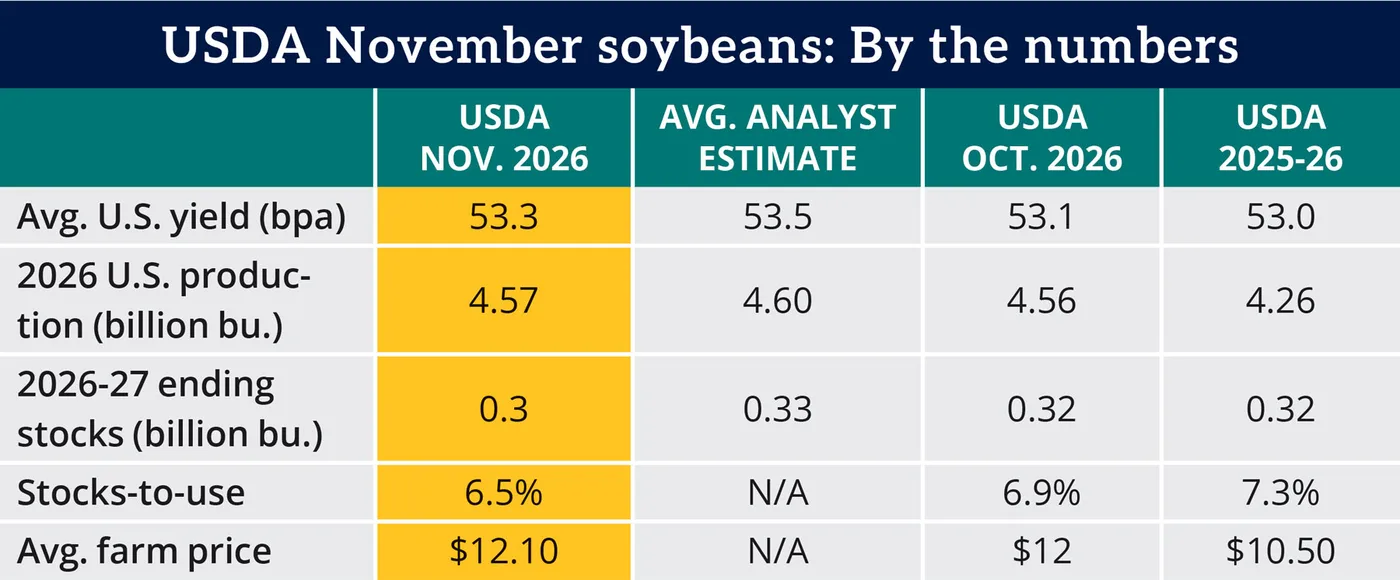
U.S. soybean export commitments totaled 32.89 million metric tons in the latest weekly update, 80% ahead of the year-earlier pace. Actual shipments were up 59%. Even with a record U.S. crop estimated at 4.57 billion bushels, the U.S. Department of Agriculture’s November report projected ending stocks of 300 million bushels, a four-year low equivalent to 6.5% of annual use. January beans traded at $12.34 a bushel, compared with $11.85 for November 2027 delivery.
The tight U.S. inventory forecast did not point to a worldwide shortage. USDA forecast a record Brazilian crop of 186 million metric tons. China imported 7.35 million metric tons of soybeans in October, down 22.5% from a year earlier, according to customs figures reported by Global Agriculture.
Why strong fuel demand did not lift soybean oil
U.S. biofuel producers used a record 1.687 billion pounds of soybean oil in July, up 52% from a year earlier, according to the Energy Information Administration. Yet by Nov. 24, soybean oil had fallen about 18% from the start of September and recorded its lowest close since late February, Farm Futures reported.
The federal 45Z low-carbon fuel production credit and finalized renewable fuel blending requirements for 2026 and 2027 support demand for biofuel feedstocks. Neither sets a price for soybean oil. As diesel gets cheaper, so does the fuel that soybean oil-based biodiesel and renewable diesel compete with. AAA’s national retail diesel average fell from a record $6.5276 a gallon on Sept. 22 to $5.8182 on Nov. 23, a decline of about 11%.
What the processors told investors
ADM’s third-quarter crush profit rose to $311 million from $13 million a year earlier. The company reported adjusted earnings of $1.77 a share and raised its 2026 adjusted earnings forecast to $5.50–$5.80 a share from $5.15–$5.60. Its shares nonetheless fell 6.5% on the day of the earnings report.
Bunge reported earnings of $2.56 a share and maintained its full-year forecast of $9.25–$9.75. It did, however, lower its outlook slightly for full-year soybean processing and refining results. Its shares fell 4.1% on the report, before the separate 8.60% decline on Nov. 24.
Both companies also earn money from activities beyond crushing, including storage and logistics, so a one-day change in the spread does not explain either share move on its own. What the Nov. 24 futures prices show is narrower: buyers paid more for a bushel of beans, but processors stood to keep slightly less from turning it into meal and oil.