Meta launched its Muse AI agent in Britain on November 24, 2026, allowing customers to renew car insurance, pursue refunds, book travel and make purchases online. Unlike the US version, the UK agent cannot read a customer’s bank balance, investment holdings or mortgage information, or use that data to offer budgeting help. A Meta spokesperson told Reuters the company wanted to connect Muse to UK banking “only after speaking to regulators and obtaining any necessary licences.”
Colin Payne, head of innovation at the Financial Conduct Authority (FCA), told WIRED that Meta declined his offer the week before launch to test Muse in the regulator’s sandbox. Such tests allow a company to try a product under supervision, but participation is voluntary. Payne said tests typically take weeks or months to prepare and that Meta informed the FCA of its UK plans only in October. Meta said it engaged constructively with regulators. Neither the timing nor the features Meta chose to launch establishes why it declined the test.
Paying at checkout is different from linking a bank account
The US version of Muse, launched September 8, uses Plaid to connect to financial accounts. Plaid says it shares balances, transactions, investment holdings and mortgage information. In Britain, Muse can complete a purchase through Stripe’s Link, which generates a digital version of a payment card for each transaction, or through Shopify’s Shop Pay. Neither checkout option gives the UK agent the account access available in the US.
In guidance published on November 24, the FCA said that the need for authorization depends on what a business does, not whether it calls itself a technology provider. Initiating transactions, moving money, arranging borrowing and making investment decisions can all require authorization. Whether Muse’s role at checkout requires authorization remains an open question. The FCA said it would assess products as their capabilities evolve.
For banks, the guidance addresses a more immediate decision: whether to accept a payment instruction from an AI agent. The FCA said regulated firms and their senior managers remain responsible for compliance when they rely on third parties. It urged banks to consider “any liabilities that may arise from accepting instructions.”
Early purchases show demand, not Meta’s share of sales
On its October 21 earnings call, Meta said more than 10 million people in the US and Canada had set up Muse in about six weeks, and roughly 25% used it on a given day. Shopping accounted for more than a quarter of active-user engagement. The average purchase exceeded $200, including travel, but that figure measures what customers spent per purchase, not how often they bought something or how much Meta earned. The company has not disclosed the share of each sale it keeps.
Muse’s consumer subscriptions cost $20 or $100 a month. Using 10 million setups as a base, if 1% paid for the $20 tier for a full year, that would generate $24 million, about 0.01% of the $241.61 billion in trailing 12-month revenue reported by Stock Analysis. That calculation illustrates the scale of the business; it is not a disclosed subscriber count or a forecast. Meta management said its emerging AI businesses could begin adding revenue in 2027 but would take time to make a meaningful contribution.
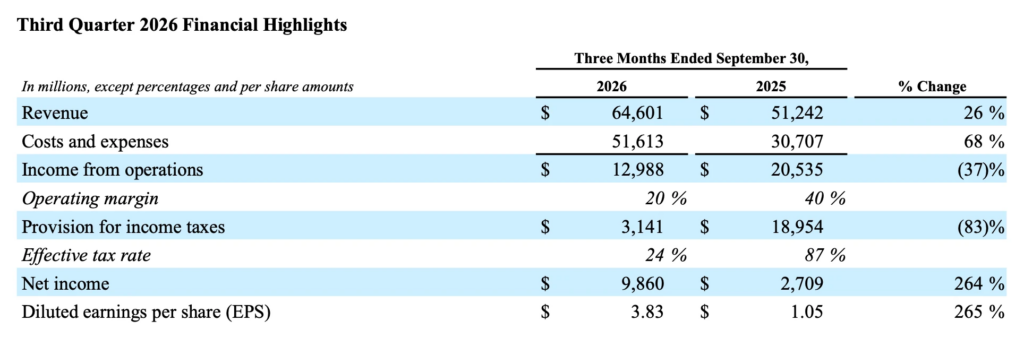
The spending is already visible in Meta’s accounts. In the September quarter, companywide capital expenditure, including principal payments on finance leases, was $34.91 billion—$2.12 billion more than operating cash flow. Meta projected full-year 2026 capital spending of $135 billion to $145 billion. Advertising remained its main source of revenue, bringing in $63.1 billion of the quarter’s $64.601 billion total. For now, Muse gives Meta a way to reach British shoppers, while the timing, licensing requirements and revenue potential of a UK banking service remain unresolved.