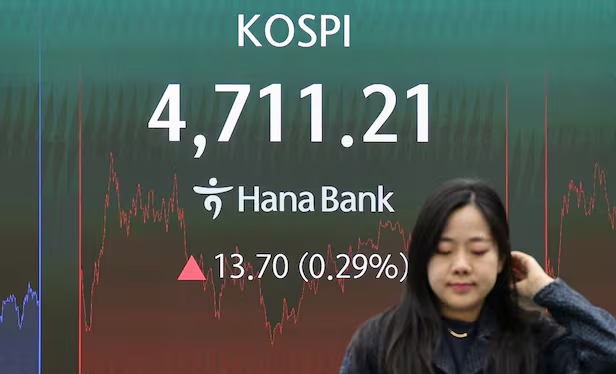
South Korea’s Kospi gave up most of its early gains on Nov. 26, 2026, closing up 13.70 points, or 0.29%, at 4,711.21 after falling more than 6% the previous day. The benchmark opened 1% higher and reached 4,817.77 before retreating. It ended the session 48% below its June 22 peak of 9,114.55, though still above its level a year earlier.
Samsung gained 0.4% and SK Hynix rose 2.2%. Together, the two chipmakers account for close to half the Kospi’s market value. Their influence was particularly clear on Nov. 20, when they accounted for roughly two-thirds of the index’s 5.21% decline. Taiwan’s market followed a different pattern on Nov. 26: the Taiex rose 2.5% even as its leading chipmaker, TSMC, fell 0.2%.
AI spending concerns outlast a regional rally
Just two sessions earlier, on Nov. 24, Taiwan’s market had jumped 9% and Samsung and SK Hynix had each gained more than 8%. The rally followed Jensen Huang’s return as Nvidia’s chief executive and a 31.5% surge in Nvidia shares in New York. On Nov. 25, both Korean chipmakers fell more than 9%.
Bloomberg attributed the reversal to concerns about how companies would finance their AI investments and how much that spending would weigh on earnings. Saxo’s Charu Chanana described the selloff as “a valuation reset and a positioning unwind at the same time,” saying the Nov. 24 rally “may have offered an opportunity to exit positions.”
U.S. tariff proposals offered little direct explanation for the Korean chipmakers’ Nov. 26 gains. The proposals covered 14 major trading partners, including China, Japan and the European Union. Reuters reported that the proposed rates would not be added to those imposed in July, were unlikely to take effect before February or March 2027, and would exempt key technology imports, including semiconductors. JPMorgan analysts described the likely economic impact as “likely modest.”

Investors changed sides as the index swung
Korean retail investors bought a net 1.595 trillion won of shares during the Nov. 20 selloff, with 95.2% of that amount going into electronics. On Nov. 26, they sold a net 1.297 trillion won on the main market, while institutional investors bought a net 928.7 billion won.
The same concentration that shaped the Kospi’s swings also matters for investors in the U.S.-listed iShares MSCI South Korea ETF. Samsung and SK Hynix together represented 43.17% of its net assets as of Aug. 31, and information technology accounted for 51.56%.
The stock market’s retreat contrasted with an improving domestic growth outlook. On Nov. 26, the Bank of Korea raised its policy rate by 0.25 percentage points to 3.25%. It also lifted its growth forecasts to 3.9% for 2026 and 4.1% for 2027. The Kospi, however, had already risen 116% for the year by its June peak. From its Nov. 26 close, it would take a gain of about 93% to return to that level.