Infleqtion (NYSE: INFQ) reported on September 24, 2026, that it had entangled 30 logical qubits using 80 laser-trapped atoms. That works out to about 2.7 physical qubits for each logical qubit, well below the company’s target of 10. The experiment reached its milestone a quarter early, but it did not establish how much hardware Infleqtion will need for a machine that can sustain a long calculation.
For investors, the distinction matters because Infleqtion has published two figures for the same 2028 goal: 100 logical qubits capable of one million reliable operations. On a November 16 call, the chief technology officer said the machine could need “as few as 2,000 physical qubits.” The company’s roadmap lists 10,000. That is a fivefold difference in the number of atoms the hardware would have to support, not a measured fivefold difference in cost.
What the 80 atoms demonstrated
A logical qubit stores quantum information across multiple physical qubits to protect it against errors. Infleqtion arranged its 80 atoms in ten blocks of eight, each encoding three logical qubits. That brought its demonstrated count from two logical qubits in 2024 and 12 in 2025 to 30 in September 2026.
The experiment ran about 1,000 physical operations but used only one round of error correction and detection, according to the CTO. The code used during the experiment could detect a single error but generally could not correct it. A missing atom was an exception: because the machine knew where the loss occurred, it could recover some missing measurements. Infleqtion discarded runs with detected errors and said its loss-correction step quadrupled the number of usable runs, at some cost in accuracy. Discarded runs still consume machine time, a cost that the atom count does not capture.
Accuracy also changes the comparison with competitors. Infleqtion reported per-logical-qubit success rates of 99.9% and 99.2% in its experiment. Quantinuum reported 99.9995% logical fidelity on its Helios machine, or five errors per million operations, using 10 physical qubits per logical qubit with one code and up to 37 with another. Infleqtion used fewer physical qubits; Quantinuum reported fewer errors. Neither result by itself establishes the cost of running a long algorithm.
From a code block to a complete machine
The counting question applies even to the September milestone. Infleqtion’s roadmap lists 4,000 physical qubits alongside the 30-logical-qubit milestone on the same page that describes the 80-atom experiment. For 2028, the CTO’s lower estimate implies 20 physical qubits per logical qubit, while the roadmap implies 100. The roadmap also uses a 100-to-one ratio for its 2030 “utility scale” target of 1,000 logical qubits.
One possible explanation is that the figures count different things: atoms in the code blocks, atoms used during a computation, or the capacity of a complete machine with room to move atoms and replace lost ones. Infleqtion’s public materials do not reconcile the counts. The distinction affects system design because the atoms require laser cooling, trapping and readout. As of late November 2026, the full technical paper that Infleqtion had promised in September was not yet public.
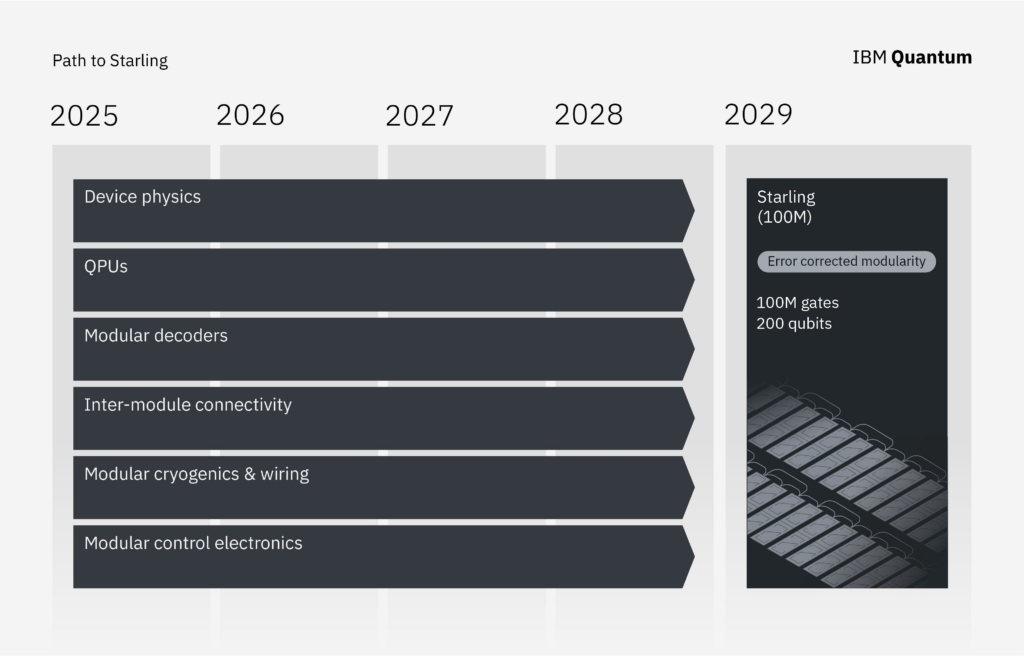
Infleqtion’s CTO identified three tasks for the 2028 system: repeat error correction over many rounds, use codes that protect against more errors, and replace lost atoms during a calculation without destroying the stored state. Competitors’ longer-term figures are targets as well. IBM, for example, aims for its Starling system to run 100 million operations with 200 qubits in 2029.
What the valuation implies
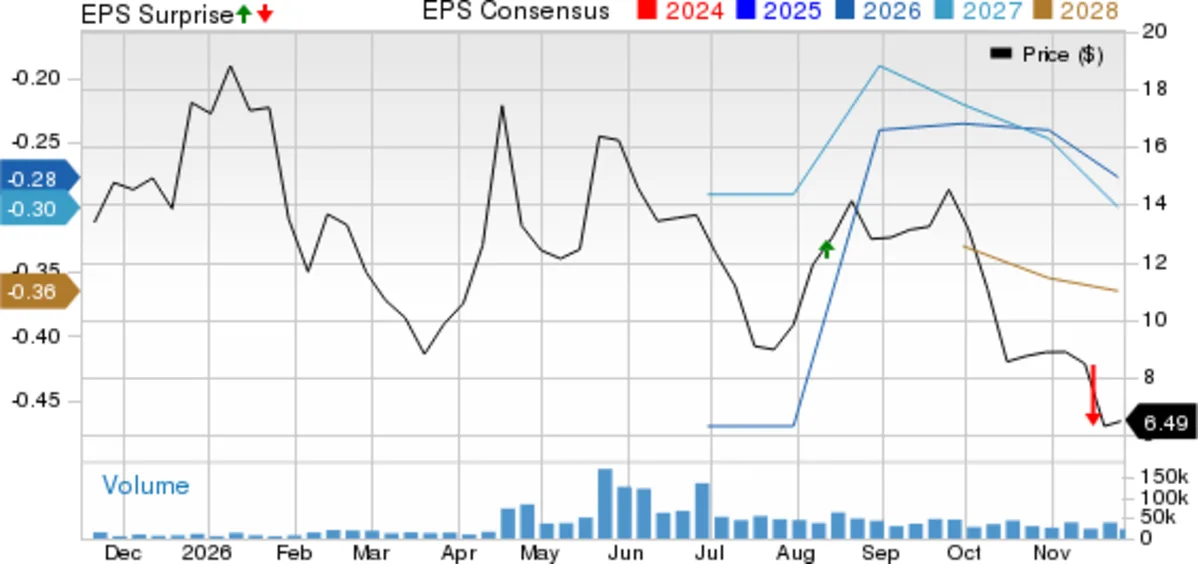
Infleqtion went public through a SPAC merger in February 2026, raising $540 million in a deal announced at a $1.8 billion pre-money valuation. On November 25, its shares traded at $6.49, valuing the equity at about $1.47 billion, according to S&P Global Market Intelligence data published by StockAnalysis. That was roughly 33 times the floor of management’s 2026 revenue guidance of at least $45.1 million, or about 20 times after subtracting the company’s $560 million cash balance.
Infleqtion reported third-quarter revenue of $9.1 million, up 25% year over year, and a GAAP operating loss of $34.5 million. It used $16.3 million in cash from operations and spent $5.2 million on capital expenditures. Revenue for the first nine months was $32.6 million, up 57%. Management expects computing to account for a meaningfully larger share of the business in 2027. The contracts it highlighted, however, were in sensing, including a $20 million expansion that brought a NASA gravity-sensor contract to $40 million and a roughly $12 million UK award for a radio-frequency sensor.
The September result shows that Infleqtion can encode and entangle 30 logical qubits with relatively few atoms. The commercial test is whether it can retain that hardware advantage while correcting errors throughout a long calculation. Reporting both the full system’s atom count and the number of reliable operations it completes would make that progress easier to assess.