The UK’s Medicines and Healthcare products Regulatory Agency approved Regeneron’s Lynozyfic on November 27, 2026, for adults whose multiple myeloma has returned after at least three prior therapies. The licence allows Regeneron to sell the drug in the UK, but it does not determine whether the NHS in England will pay for it.
Regeneron’s third-quarter filing shows why that distinction matters. Of Lynozyfic’s $19.0 million in global net sales for the quarter, $18.6 million came from the United States. Sales across all markets outside the US were $400,000 for the quarter and $1.2 million for the first nine months of 2026. Those figures include the European Union, which approved the drug for the same patient group in April 2025; they are not UK sales figures.
What the funding review could change
England’s National Institute for Health and Care Excellence (NICE) scheduled its first appraisal committee meeting for December 1, 2026, with guidance expected on February 17, 2027. NICE could recommend Lynozyfic for the licensed population, restrict its recommendation to a subgroup or decline to recommend it.
A comparison with the US gives a sense of the potential revenue, though not a forecast. Cancer Research UK counts 6,532 new myeloma diagnoses a year in Britain, while the American Cancer Society estimates about 36,000 in the US in 2026. Scaling Lynozyfic’s third-quarter US sales by that ratio yields roughly $3.4 million a quarter in Britain, or 0.07% of Regeneron’s quarterly revenue. That calculation assumes comparable uptake and US net prices. British prices are lower, but the UK licence covers patients after three prior therapies rather than the four required in the US. New diagnoses are also not a count of patients eligible for later-line treatment.
The evidence for a larger market
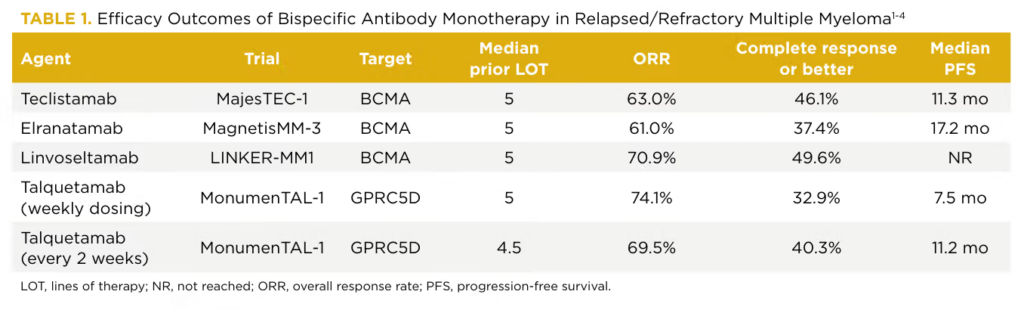
Lynozyfic, also called linvoseltamab, is a bispecific antibody that brings T cells into contact with myeloma cells. According to the European Medicines Agency’s assessment, about 71% of 117 patients responded in a study with no control group. About 50% had a complete response, and responses lasted an average of 29 months. The label warns of cytokine release syndrome and neurological toxicity.
The study excluded patients previously treated with a bispecific antibody or CAR-T therapy directed at the same target, BCMA. Its results are therefore a less certain guide for patients who have already received those treatments. Lynozyfic does offer a scheduling difference: patients who respond can move to an infusion every four weeks from week 24.
As a condition of EU approval, Regeneron must conduct a randomised trial comparing Lynozyfic with a standard three-drug regimen in patients who have received one to four prior therapies. That trial could support use earlier in the disease, but an expanded indication is not assured. In the first nine months of 2026, Regeneron reported $202.0 million in direct research and development spending on the programme against $46.7 million in global Lynozyfic sales.
Sanofi’s contribution to Regeneron’s growth
Lynozyfic accounted for 0.37% of Regeneron’s $5.12 billion in third-quarter revenue. Total revenue rose 36% from $3.75 billion a year earlier. Of the reported $1.36 billion increase, $1.11 billion came from the Sanofi collaboration and $185 million from Libtayo. Together they accounted for about 95% of the increase; Lynozyfic contributed $18 million, or 1.3%.
The Sanofi increase reflected not just drug sales but how much Regeneron kept. Its $2.57 billion share of profits from Dupixent and Kevzara equalled 38% of the drugs’ combined $6.80 billion in sales, up from 29% a year earlier. Regeneron finished repaying its development balance to Sanofi in June 2026, eliminating a $268 million quarterly payment that had been deducted from collaboration revenue. Operating leverage also contributed. At the earlier 29% rate, the same sales would have yielded about $1.97 billion for Regeneron, roughly $600 million less than it recorded.
The end of those repayments raises Regeneron’s ongoing share of profits, but the change in rate does not produce the same growth each year. A separate $1.0 billion upfront payment under the amended Sanofi agreement is due to be recorded as fourth-quarter collaboration revenue and will not recur. Meanwhile, combined global sales of Eylea and Eylea HD fell 11% to $1.74 billion in the third quarter.
For Lynozyfic, the next financial evidence will be more specific than Regeneron’s overall revenue growth: whether NICE recommends NHS funding in England and whether sales outside the US rise from their $400,000 quarterly level. Neither outcome was settled by the UK licence.