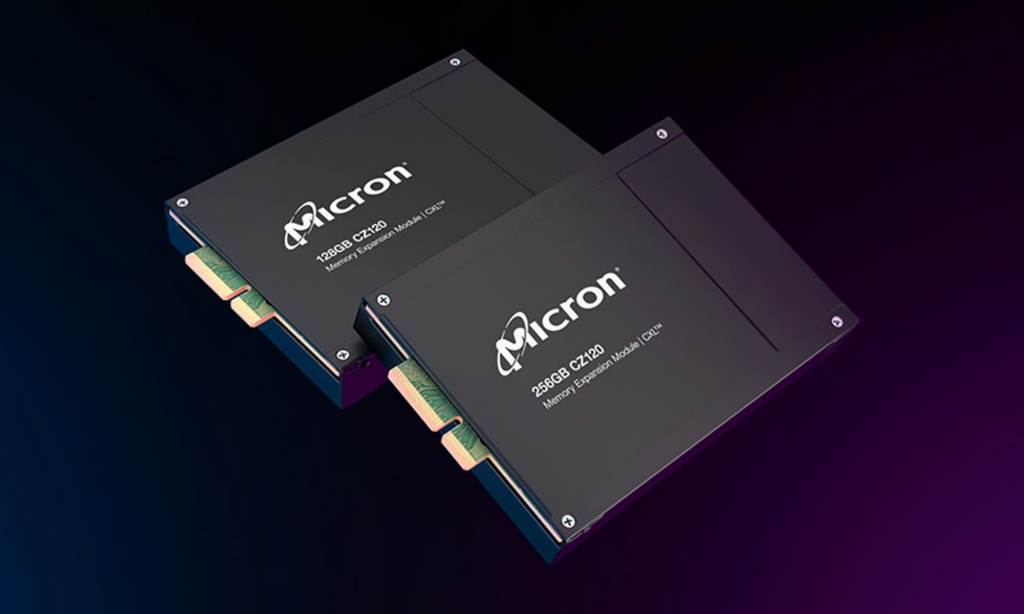
Micron Technology shares closed at $646.95 on Nov. 27, 2026, up 7.6% in a shortened trading session. The gain came as GF Securities, citing order cuts by Chinese cloud providers, lowered its forecast for 2027 DRAM contract prices. The firm still counted Micron among its preferred picks: it expected supply to remain tight through 2028 and said producers could cut output to support contract prices.
The rally extended across memory and storage companies. SanDisk rose 15.96%, Western Digital gained 7.22% and Seagate added 7.90%, compared with a 0.80% gain for Nvidia. For Micron, it was another sharp reversal: the shares fell 13.9% on Nov. 20, rose 19% on Nov. 23 and declined 11% and 4.5% over the next two sessions. Even after the Nov. 27 rebound, they remained about 47% below their June 25 high of $1,213.56.
Why slower price growth matters
DRAM, the working memory used in servers and PCs, accounted for $39.8 billion, or 73%, of Micron’s fiscal fourth-quarter revenue. The amount of DRAM capacity it shipped, measured in bits, rose by a mid-single-digit percentage from the previous quarter, but prices rose by a high-teens percentage. Prices also outpaced volume growth in NAND flash storage, rising about 30% against roughly 10% growth in bits shipped. Micron posted total quarterly revenue of $54.2 billion and a gross margin of 87.0%.
GF Securities now expects quarterly DRAM contract price gains of 6%, 3%, 0% and 0% in 2027, down from 10%, 7%, 5% and 3%. That forecast calls for prices to stop rising in the second half, not to fall. TrendForce also expects prices to level off in the second half of 2027 but projects a decline in early 2028. BNP Paribas brought its estimate for when supply and demand would balance forward by a year to mid-2027 and cut its Micron price target from $1,700 to $775.
Contracts protect some revenue as Micron builds capacity
Micron says it has sold about 75% of its 2027 output. Its 26 strategic customer agreements cover more than 35% of estimated revenue through 2030 and require customers to buy the committed volume or pay for it. Micron put the remaining obligations under those contracts at about $150 billion at minimum prices. Customers have committed $32 billion, mostly in cash deposits.
Those agreements offer protection, but they do not fix prices across Micron’s business. About three-quarters of contracted revenue has a defined pricing framework, most of it with floors and ceilings. Management expects fiscal 2027 and 2028 to be tighter than fiscal 2026 and says that even at contract floors, it expects margins to remain well above previous cycle peaks.
The expansion schedule helps explain why analysts can agree on near-term scarcity and disagree about 2028. After spending $30.7 billion on capital projects over 12 months, Micron plans to spend about $25 billion in the first half of fiscal 2027 alone and more in the second half. Most of the increase is for construction rather than equipment, so it will not immediately add chips to the market.
Micron expects its first Idaho plant to begin wafer output in mid-2027, around the time its Tongluo facility in Taiwan starts shipping significant volumes. Its second Idaho plant and its Japanese DRAM plant are scheduled to begin output in late 2028. A new Singapore NAND plant is scheduled to start in the second half of 2028.
What the share price assumes
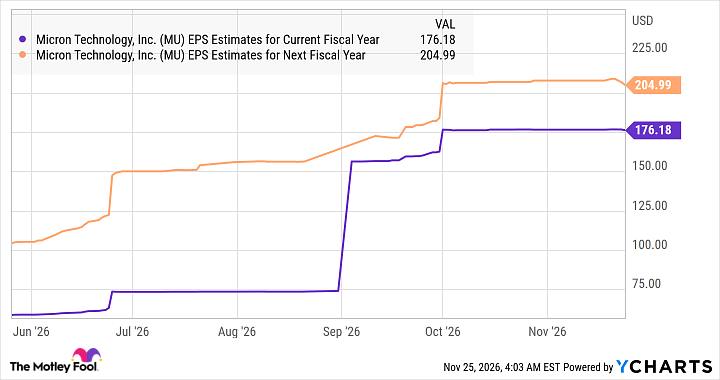
At its Nov. 27 close, Micron traded at about 8.5 times trailing non-GAAP earnings and 3.7 times TIKR’s fiscal 2027 consensus estimate of $176.18 per share. The distinction is how much of those earnings Micron can sustain if memory prices weaken. Trefis identified eight previous gross-margin peaks: after each, the margin fell at least 10 percentage points within one to five quarters. That is a small historical sample, not a forecast of how the new contracts will perform.
An illustrative calculation shows the sensitivity. At $275 billion in annual revenue, an 86% gross margin would yield roughly $166 per share, assuming $12 billion in operating expenses, a 15.5% tax rate and 1.15 billion shares. At the same revenue but a 45% gross margin, earnings would be about $82 per share. Neither scenario is company guidance.
Micron is scheduled to report fiscal first-quarter results on Dec. 17, 2026. Management guided to $61.5 billion in revenue, an 86.25% gross margin and earnings of $38.15 per share. It also expects revenue to grow each quarter of fiscal 2027. The second-quarter outlook will offer a nearer-term test than the 2028 factory openings: a revenue forecast only about 5% above the first-quarter result could be consistent with shipment growth alone, without a further rise in prices.