Finance and central bank deputies from the 11 ASEAN members, China, Japan and South Korea endorsed a program in Kyoto on November 26, 2026, to study how to connect retail and wholesale payment systems across borders. The program at the ASEAN+3 Macroeconomic Research Office establishes a working group. The 14 governments did not adopt a common rulebook, launch a network or set a start date.
A separate project called Nexus offers a concrete example of what such links could mean for banks and payment companies. Under its design, the operator would charge for connecting domestic payment systems, but it would not set the full price of a transfer. A bank could still earn money converting currencies and providing the accounts used to settle the payment.
What Nexus would charge for
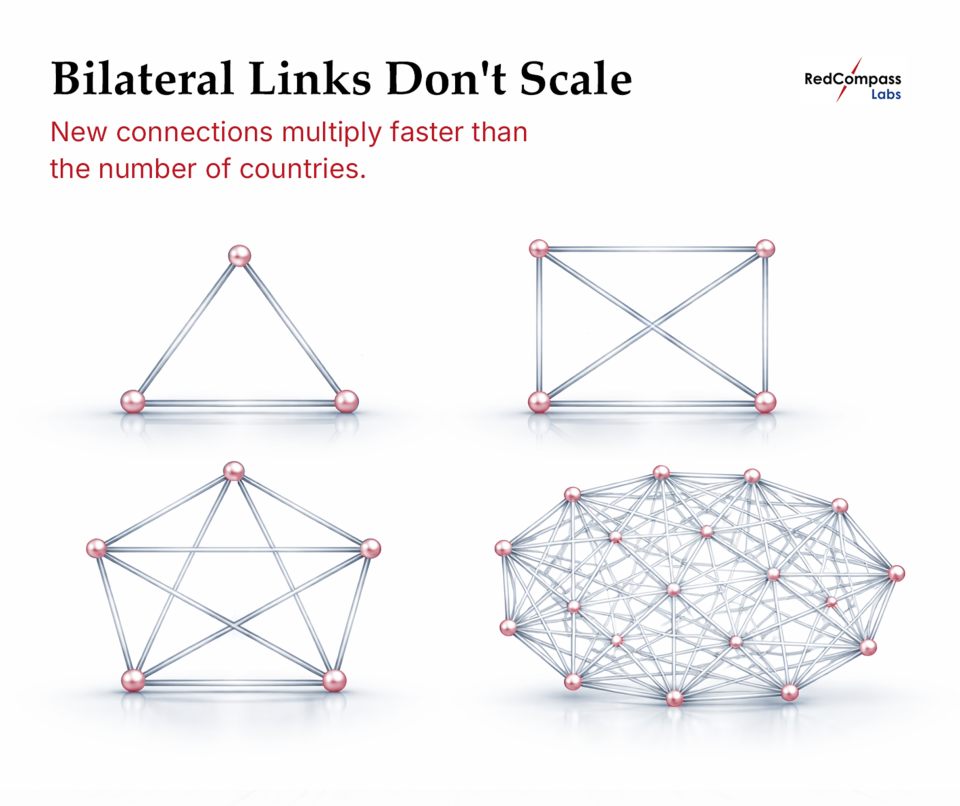
Nexus was incorporated in Singapore in 2025 as a not-for-profit company established by the central banks of India, Malaysia, the Philippines, Singapore and Thailand. Indonesia joined in 2026. The idea is for each domestic instant payment system to connect once to a common hub, rather than negotiate a separate connection with every country. Systems such as India’s UPI, Singapore’s PayNow and Thailand’s PromptPay could then exchange payment instructions without adopting a new currency. As of November 2026, Nexus had not gone live for consumers.
The Nexus blueprint sets only two fees centrally: the scheme fee and the destination provider fee. Payment service providers and domestic instant payment systems set their own charges. The foreign-exchange provider quotes the exchange rate, and the institution providing access to a settlement account negotiates its fee. A bank can fill all three roles: handling the customer’s payment, converting the currency and providing the settlement account. That gives banks several ways to earn revenue even if the hub itself charges little. It does not guarantee them a margin on currency conversion, where providers compete.
Other regional projects address different problems. The Monetary Authority of Singapore launched BLOOM in October 2025 to test rules for settling payments in regulated stablecoins and tokenized bank deposits. Malaysia’s and Thailand’s central banks joined as policymaker members on October 23, 2026. BLOOM remains a testing environment, not a payment service operating at scale.
By contrast, mBridge was designed to let central banks settle directly in their own digital currencies. The Bank for International Settlements withdrew in October 2024, and Saudi Arabia’s central bank said it exited in May 2025 after completing a proof of concept. According to Ledger Insights, the digital renminbi accounted for 95% of the platform’s transaction volume through 2025.
What card-network revenue measures
Visa’s fiscal 2026 annual report puts the network’s share of payment activity in perspective. Its $45.9 billion in net revenue on $18 trillion in payments and cash volume worked out to about 25.5 cents per $100 across its business. That average is neither the price of a cross-border transaction nor the full fee a merchant pays. The merchant charge also covers interchange for the cardholder’s bank and a margin for the institution serving the merchant.
Visa reported $15.3 billion in international transaction revenue, equal to 33% of net revenue. That revenue grew 8% in fiscal 2026, while cross-border volume excluding transactions within Europe rose 15%. The measures do not cover exactly the same transactions. Visa attributed the difference to “lower volatility of a broad range of currencies and business mix.” The gap alone is not evidence that new Asian payment links have reduced Visa’s pricing.
Mastercard’s figures illustrate why the distinction matters. In calendar 2025, its cross-border assessments rose 18%, matching growth in cross-border volume measured in dollars. Those assessments are gross charges before rebates, not a direct equivalent of Visa’s international transaction revenue. Both companies also reported faster growth in services: Visa’s value-added services revenue rose 31% to $14.2 billion in fiscal 2026, while Mastercard’s services revenue grew 19% in the third quarter of 2026, compared with 11% for its payment network.
Cambodia shows how cards and QR payments can coexist
Cambodia’s Bakong system processed about 1.33 billion transactions in 2025. The country has five bilateral QR payment links across ASEAN, and roughly 4.5 million merchant locations accept its standardized KHQR code. A collaboration dating to 2025 lets eligible international visitors link Visa cards to the Bakong Tourists App. A separate memorandum that the National Bank of Cambodia signed with Visa on November 16, 2026, is exploratory: it concerns a possible connection between KHQR and Visa’s global network, not a completed integration.
At the Singapore Fintech Festival that month, Visa announced plans to roll out Scan to Pay with Alipay+, connecting eligible Visa cards to merchants that accept Alipay+ QR payments. Ant International and BNY signed a memorandum to explore round-the-clock foreign exchange and cross-border settlement. The agreement did not launch a settlement service.
These arrangements leave room for a national operator to maintain the merchant payment standard while private firms supply card acceptance, fraud prevention, dispute resolution or currency conversion. How much business each participant wins will depend on actual usage and pricing. A common message format can spare payment operators the work of building a link for every country pair. It cannot, by itself, reconcile capital controls, transaction limits or anti-money-laundering checks. Until systems such as Nexus carry consumer traffic, their fee schedules say more about who could earn revenue than how much will change hands.