The Bank of Japan is examining two ways for financial institutions to settle tokenized trades: issue central bank money as a token, or connect outside blockchain platforms to BOJ-NET, the bank’s existing payment system. Both would keep the final payment in central bank money. The bank has not chosen between them.
At an IMF seminar in Tokyo on November 27, 2026, Bank of Japan Executive Director Kazushige Kamiyama explained why that distinction matters. A yen held as a token must be convertible at face value into a yen held in a bank account, and a settled payment must be final. “The singleness of money should not be taken for granted,” he said in his prepared remarks.
The bank’s DLT Sandbox Project focuses on payments between financial institutions: cross-border transfers, domestic interbank settlement and the cash side of trades in tokenized Japanese government bonds. It is separate from the bank’s retail digital currency pilot. The bank has made no decision to issue a digital yen.
Why bond dealers care about settlement hours
Japan’s government bond repurchase market shows what a change in settlement could mean for banks and dealers. In a repo, a dealer can borrow cash against bonds. The market was estimated at more than ¥250 trillion, according to Crowdfund Insider’s account of materials presented to a Ministry of Finance study group in November 2026. Roughly 40% of activity clears directly between counterparties. Settlement is concentrated in Japanese business hours, so participants in London and New York often have to finalize instructions the previous business day.
A proposal described in the study group materials would test tokenized government bonds alongside two forms of payment: tokenized bank deposits and stablecoins. The aim is delivery versus payment: the bond changes hands only if the cash does, in the same step. If dealers could complete both transfers around the clock, they might need to set aside less cash and collateral ahead of a trade. The proposal calls for a test network, not live repo settlement.

The megabanks’ plan starts with securities trades
MUFG, Mizuho and Sumitomo Mitsui Banking Corporation (SMBC) separately plan to establish a yen stablecoin through a licensed trust bank. They are targeting live commercial transactions by March 2027. According to SMBC’s global head of digital and innovation, access would initially be limited to approved participants, and the first use would be settling trades in security tokens.
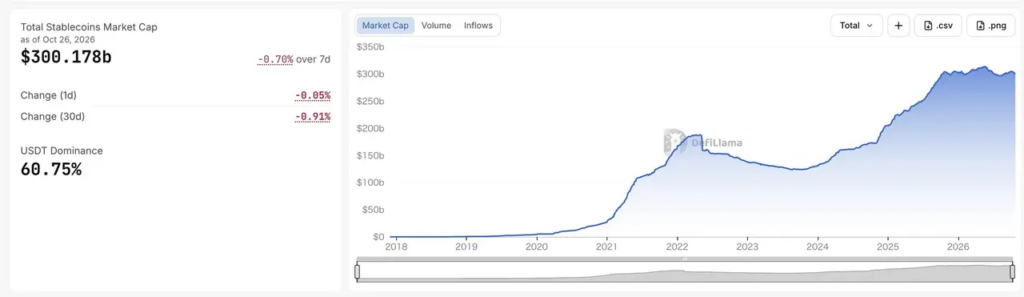
Japanese rules restrict issuance of fiat-pegged stablecoins to licensed banks, registered money transfer agents and trust companies, and require issuers to guarantee redemption at face value. Adoption remains limited: JPYC, the first regulated yen stablecoin, had just over ¥3 billion in circulation a year after launch, despite cumulative issuance of more than ¥10 billion. By comparison, the global stablecoin market was worth about $300 billion in late October 2026, according to DeFiLlama data.
Interest rates help explain the appeal of a token that a trader holds only briefly. The Bank of Japan’s policy rate has been 1.25% since September 24, 2026. If ¥1 billion could otherwise earn that rate, holding it in a non-interest-bearing token for a year would mean forgoing ¥12.5 million. Holding it for the duration of a securities trade costs far less. SMBC’s Tomoya Hasebe expects stablecoins to find a role in securities settlement and tokenized bank deposits to be more useful for ordinary business payments.
What the tests have yet to establish
Project Agorá, a cross-border experiment led by the Bank for International Settlements (BIS) that includes the Bank of Japan, has tested transfers of real value. In July 2026, 28 institutions and central banks used tokens representing central bank reserves and commercial bank deposits in six currencies, including yen. The BIS reported about CHF 800,000 across 30 transactions and 17 scenarios. Settlement took roughly 80 seconds on average from initiation, but the prototype was not yet connected to existing real-time settlement and core banking systems.
Speed alone does not settle the business case. If a bond can trade around the clock but central bank money is available only during limited hours, banks may need more cash on hand or have to divide it among platforms. As Kamiyama put it, “faster settlement does not automatically mean more efficient liquidity management.” The bank’s approach is to keep improving BOJ-NET while testing the alternatives, rather than commit to replacing the system that makes yen payments final.