The city of El Segundo said the flames and black smoke at Chevron’s refinery after the Nov. 28, 2026, earthquake were the result of “safety flaring.” The plant supplies about 40% of Southern California’s jet fuel, including fuel for Los Angeles International Airport. As of Saturday afternoon, no major refinery damage had been reported, and no public update had identified which units, if any, had stopped or how much production the plant had lost.
The magnitude 5.0 quake struck at 9:30 about three miles off Manhattan Beach. Windows shattered in Terminal 7 at the airport, and a jet on approach was told to go around. Smoke rose from the refinery seconds after the shaking began. According to a Chevron fact sheet cited by the New York Post, equipment shuts down automatically during a process interruption and sends excess gas to the flare. That explains why flames were visible without establishing that the whole refinery had shut down.
Why jet fuel prices matter at El Segundo
An earlier interruption at the plant shows why the affected units matter as much as the duration of an outage. On Oct. 2, 2025, a fire broke out in El Segundo’s Isomax 7 unit, which converts intermediate refinery products into jet fuel. Chevron shut several processing units, but the units that distill crude oil stayed online, Reuters reported, citing Wood Mackenzie.
Jet fuel rose 33 cents a gallon the following afternoon, according to GasBuddy data cited by Reuters. The gasoline increase, by contrast, was forecast at 5 to 15 cents a gallon. El Segundo supplies about one-fifth of Southern California’s motor fuel, compared with roughly two-fifths of its jet fuel.
Less capacity to replace lost production
The U.S. Energy Information Administration (EIA) listed El Segundo’s crude processing capacity at 285,000 barrels a day on Jan. 1, 2026. Only Marathon Petroleum’s Carson refinery was larger in California. El Segundo accounted for 19% of the state’s 1.5 million barrels a day of operable capacity at the start of the year and about 21% of the roughly 1.354 million barrels a day still operating after Valero idled its Benicia refinery at the end of April.
The Benicia idling and Phillips 66’s October 2025 closure of its Los Angeles refinery together removed about 284,000 barrels a day of capacity. That was nearly the size of El Segundo and about 17% of California’s capacity at the start of 2025. Across the broader West Coast refining district, plants ran at 95.7% of operable capacity in August 2026, according to the EIA.
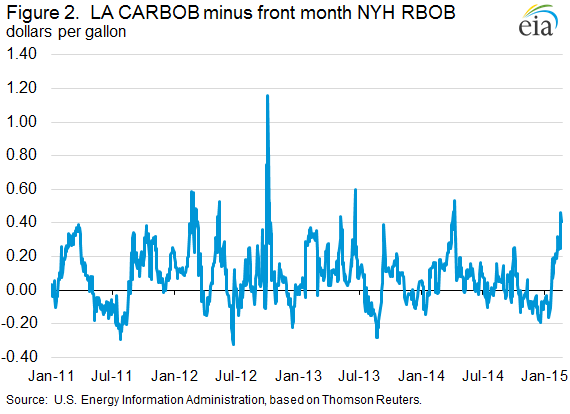
Replacement fuel takes time to reach Southern California by tanker, and the state’s gasoline specifications limit which supplies it can use. After the February 2015 explosion at the Torrance refinery, the Los Angeles wholesale benchmark for California-grade gasoline rose 22 cents in six days, to $2.02 a gallon. Its premium over the national gasoline futures benchmark widened from 25 cents to 41 cents a gallon. Those figures describe the Torrance outage, not a price response to the November 2026 quake.
What an outage would mean for refiners
A sustained outage could cost Chevron the refining margin on fuel it cannot produce while raising margins for competitors that keep selling. For scale, if all of El Segundo were offline for two weeks at an assumed margin of $10 a barrel, Chevron would forgo about $40 million in margin before tax, with fixed costs continuing. Chevron reported $9.9 billion in third-quarter earnings. The $40 million is an illustration, not an estimate of earthquake losses.
PBF Energy, whose business is concentrated in refining, has 316,400 barrels a day of combined capacity at Torrance and Martinez. A $1-a-barrel increase in margin applied across that full capacity would amount to about $9.5 million over a month. Whether any such benefit materializes depends on actual refinery runs and product prices.
For the November quake, evidence of a prolonged unit shutdown or a sustained rise in the Los Angeles jet fuel premium would tell fuel buyers and investors more than the plume. As of Nov. 28, neither a prolonged outage nor a resulting earnings impact had been established.