Iraq’s crude exports reached 3.6 million barrels a day in November 2026, up from 3.4 million in October and 2.65 million in September, the Oil Ministry told the Iraqi News Agency. But moving that oil through the Strait of Hormuz remained costly. By November 20, tanker rates to China on the route through the strait were 3.1 times those on a route that bypasses it, compared with 1.6 times on October 8.
Iraq, OPEC’s second-largest producer, earned $8.8 billion from oil in October, its highest monthly total since the war began in February. The recovery came as Washington pressed Baghdad to restrict trade with Iran and Tehran urged it to preserve the neighbors’ economic ties.
Baghdad’s stake in keeping trade open
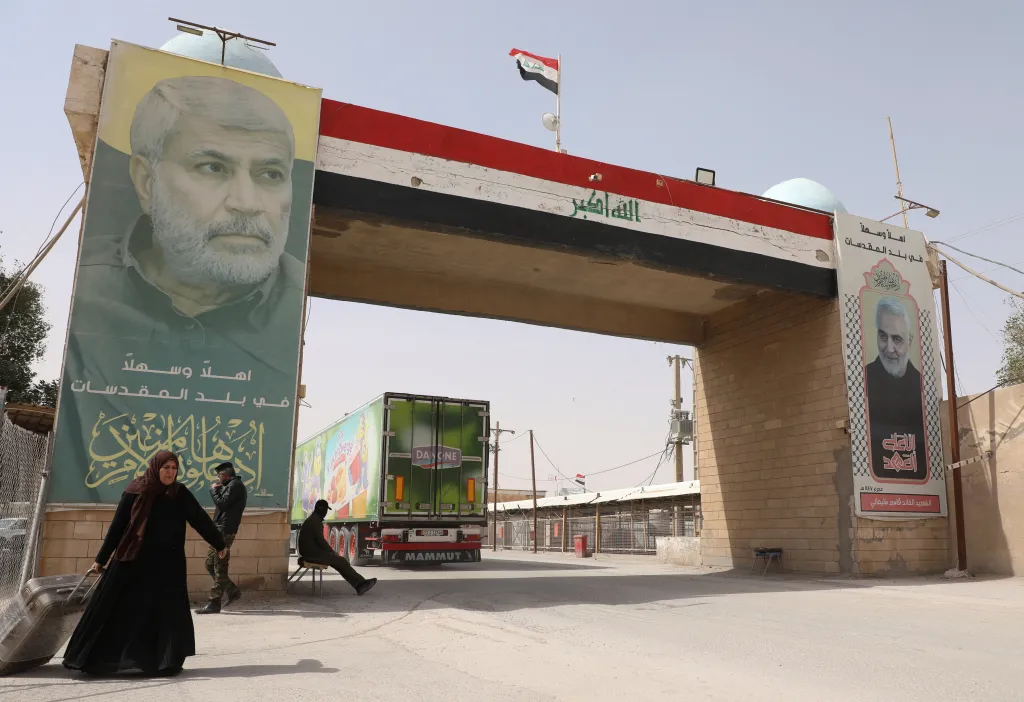
Iraq’s foreign minister said the US Treasury had asked Baghdad to close all but two crossings with Iran. That request was broader than the closures reported on November 26: Iraq shut two crossings in the semi-autonomous Kurdistan region, one with Iran and one with Syria. On November 28, Iranian security chief Mohsen Rezaei told Iraq’s visiting national security adviser that “foreigners should not be allowed to negatively impact Iran-Iraq economic cooperation.”
Baghdad depends on both countries in different ways. Iranian gas fuels plants that generate 30% to 40% of Iraq’s electricity, according to US Energy Information Administration data cited by Al Jazeera. Iraq’s oil revenue, meanwhile, passes through an account at the Federal Reserve Bank of New York. Washington threatened in 2026 to restrict Baghdad’s access to that money unless it curbed Iranian influence.
Oil accounted for 78% of Iraqi government revenue in the first seven months of 2026, down from about 90% a year earlier, as oil revenue fell 53%, according to Finance Ministry figures reported by Shafaq. The budget deficit reached $17.32 billion through July.
Iraq is seeking OPEC+ recognition of production capacity of about 6 million barrels a day; its output ceiling remains 4.431 million. It produced 4.6 million barrels a day in October, the most since September 2019, according to International Energy Agency figures reported by Bloomberg. Reuters reported that US officials had encouraged Iraq to consider leaving OPEC during the summer, but that Iraq’s Oil Ministry steered the prime minister toward seeking a larger quota instead.
A Mediterranean outlet can carry only a fraction of exports
The Kirkuk–Ceyhan pipeline to Turkey’s Mediterranean coast reopened on November 27 after 12 years, Iraq’s Oil Ministry said. Its initial capacity of 300,000 barrels a day is equivalent to about 8% of Iraq’s November export rate. Repairing a second pumping station could raise that to 500,000 barrels a day, or about 14%. Those figures describe what the line can carry, not how much crude has flowed through it.
Most Iraqi crude therefore still needs to pass through Hormuz. Iran says it decides which vessels may pass; Washington says it controls the strait and charges no toll. Ship-tracking firm Kpler found that Iran exempted vessels flagged to Iraq, Qatar, China and India. Kpler put flows through the strait at about 10 million barrels a day on November 10, down from 13.4 million at the start of the month and roughly 20 million before the war.
Crude prices and tanker rates tell different stories
Brent traded near $95 a barrel, about 25% below its April 30 high of $126.41. The January contract settled at $95.44, while February settled $4.60 lower at $90.84. That pricing pattern, known as backwardation, puts a premium on earlier delivery. The IEA said global supply rose by 2.3 million barrels a day in October to 105.4 million and could exceed demand in the fourth quarter.
Freight rates fell too, but the decline depended on the route. From the October 8 peak to November 20, rates for very large crude carriers from the Gulf of Oman to China, a voyage that avoids Hormuz, fell 61% on the Worldscale freight index. Rates from the Middle East Gulf to China through the strait fell only 22%, according to Signal Ocean data published by Riviera. That difference explains why the relative cost of using Hormuz rose even as rates on both routes declined.
For tanker owner Frontline, strong freight rates translated into average third-quarter spot earnings of $148,500 per day per ship on its largest crude tankers. The company said its fourth-quarter bookings were the highest it had recorded. It declared a quarterly dividend of $2.38 per share, equal to that quarter’s adjusted earnings per share. The payout reflected one quarter’s results, not a commitment to maintain that rate.
For crude buyers, the nearer test is whether scheduled cargoes actually load. Bloomberg reported that about 20 million to 30 million barrels of Basrah crude due in November had been delayed, with some available only in the first 10 days of December. If those cargoes load while the Hormuz freight premium persists, buyers could see more Iraqi oil without a comparable decline in shipping costs. Further delays would put the availability of the oil itself in question.