On November 27, 2026, an unlabeled Bitcoin address received 2,624 BTC from wallets that Whale Alert identified as Coinbase Institutional. The tracker valued the transfer at $156.5 million. Nine minutes and 25 seconds later, the address spent its entire balance. The blockchain shows how the coins were split, but not who owned them or whether anyone bought or sold bitcoin.
What the next block showed
The transfer was recorded at 17:36:10 UTC in block 977,827. It drew on five inputs that Whale Alert labeled as Coinbase Institutional deposit or hot wallets, and returned 15.11 BTC in change to a Coinbase hot wallet.
In the next block, the receiving address split the 2,624 BTC into 93 outputs: 50 of about 51.07 BTC each, one of 70 BTC and 42 small outputs totaling 0.26 BTC. Eleven minutes later, one of the roughly 51 BTC portions moved again.
Traders sometimes read a large exchange withdrawal as a sign that an investor intends to hold coins in cold storage, as CryptoBriefing has noted. In this case, the first recipient clearly did not hold them. The repeated amounts are consistent with a batch of payments, but they do not identify the recipients or establish the purpose of the transfer.
Why a custody label does not identify a trade
Coinbase reported 3.0 million BTC on its platform on September 30, 2026, worth $252.5 billion. A year earlier, the corresponding figures were 2.9 million BTC and $331.9 billion. Customers held more bitcoin even as its dollar value fell 24%. Coinbase separately reported $2.2 billion of its own crypto assets held for investment. A label identifying Coinbase as custodian does not identify the client behind a transfer.
An exchange-traded fund redemption is one reason coins can leave custody without a purchase. After the SEC cleared in-kind redemptions for BlackRock’s iShares Bitcoin Trust (IBIT) in July 2025, authorized participants could return shares and receive bitcoin rather than cash. According to Coindoo’s reading of the trust’s filing, IBIT delivered $2.04 billion in bitcoin for redeemed shares in the quarter ended September 30, 2026, or 76% of its $2.67 billion in redemption payments. Nothing in the November 27 transaction establishes that it was an IBIT redemption.
What fund flows showed in November
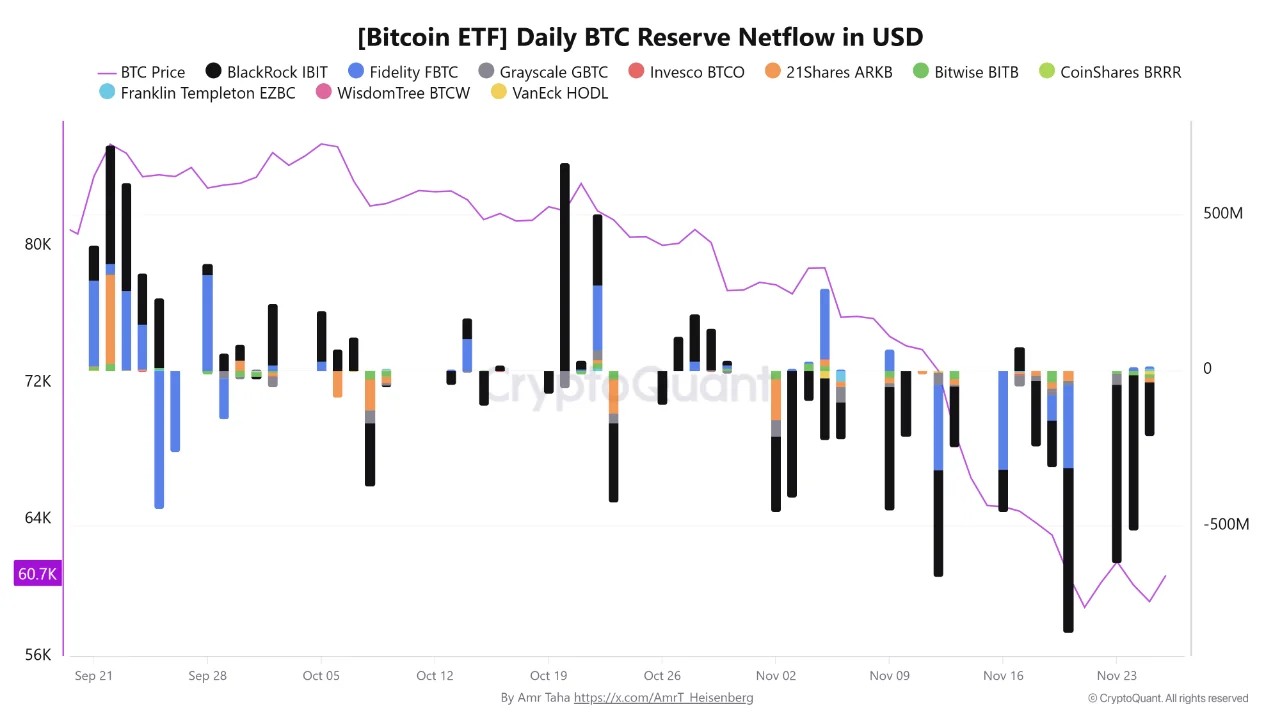
U.S. spot bitcoin ETFs recorded $5.39 billion in net outflows from November 1 through November 25, according to SoSoValue data reported by Insidebitcoins. Even with the month unfinished, that exceeded the previous full-month record of $4.51 billion in June. At $60,000 per bitcoin, the November net outflow was equivalent to roughly 90,000 BTC, about 34 times the size of the November 27 transfer.
Even for a labeled fund wallet, a transfer need not coincide with the trading session that generated it. Farside reported $541.1 million in IBIT net outflows for the November 19 session; CryptoQuant estimated $511.0 million left the fund’s wallets the following day. The figures were close but not identical. The fund data document net redemptions. The November 27 blockchain record documents a transfer and a rapid split, not a change in investor demand.