An analyst posting as @minnus calculated that the median trade in Backpack’s Anthropic token cost less to execute than a U.S. exchange trade in the stock during its IPO week in November 2026. The analyst also estimated that the token probably cost less to trade than U.S. retail investors paid. That second comparison has a practical limit: Backpack does not offer its tokenized-stock service to U.S. investors.
Anthropic, the AI company behind Claude, priced 980 million Class A shares at $83 each. The stock opened on Nasdaq at $111.50 on Nov. 19, 34% above the offer price. Backpack’s ANT token began trading on Solana minutes later. By the end of the day, listing platform Sunrise reported more than 815,000 trades, more than 13,000 holders and over $75 million in Solana ANT volume. Those rounded figures imply an average trade of about $92. That is an estimate of trade size, not a measure of execution cost.
Small trades and market depth
A median execution cost describes the middle trade when completed trades are ranked by cost. It does not show how much stock a buyer could have bought at the same price. The comparison also depends on which costs are counted. A U.S. retail order can fill at a better price than the public quote without a commission. A token swap can incur a network fee and a liquidity-pool fee in addition to the spread between buying and selling prices.
The two markets operated at different scales. Longbridge’s quote data showed about $87 billion of Anthropic stock changed hands in Nasdaq’s first session. Lookonchain counted $106 million for Backpack’s token in its first 24 hours, roughly 0.1% of the Nasdaq figure despite the different trading windows. Sunrise separately counted $134.7 million across Solana products in the first 24 hours. Neither figure is a substitute for Sunrise’s day-one volume when estimating the $92 average.
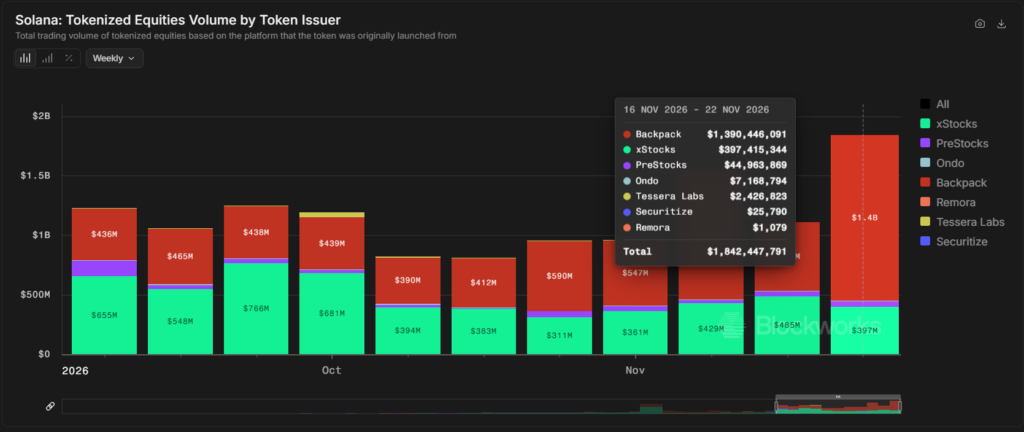
Backpack was nevertheless the largest issuer by tokenized-equity trading volume on Solana in the week through Nov. 22. It accounted for $1.39 billion of the $1.84 billion total, or about 75%, according to Blockworks data cited by SolanaFloor. That share covers tokenized equities generally, not just Anthropic.
There is reason to test how well prices hold up on larger orders. In a May 2026 study of tokenized Apple shares, Kaiko Research found average order-book depth of roughly $300,000 to $400,000 within 1% of the midpoint across crypto venues. A $1 million order could move the token price even if it barely affected Apple on Nasdaq. The study illustrates what a median execution cost leaves out; it did not measure depth in Anthropic’s token.
What an ANT holder can redeem
Backpack says eligible holders can convert ANT into Anthropic shares one-for-one without a conversion fee. That gives traders a way to narrow price gaps: when the token is cheaper, they can buy it and redeem it for stock. If the U.S. market is closed, however, a trader who receives shares remains exposed to a price change before selling them.
Under Backpack’s terms, ANT is a digital trust receipt linked to a pool of assets, not a right to a particular share. Trek Nexus Markets Ltd, a British Virgin Islands company, is the legal issuer; Backpack affiliate Trek Forge is the registered beneficiary. According to Backpack’s disclosures, RQD Clearing and Atomic Vault Securities hold the shares in the United States. Redemption normally goes through Backpack Exchange, and the terms allow payment of net sale proceeds rather than delivery of stock in some circumstances.
Backpack excludes the United States, the United Kingdom, the United Arab Emirates and Japan from its tokenized-stock service and does not offer it through Backpack EU. Sunrise also excludes U.S. persons. Eligible U.S. investors have access to the Nasdaq share and to separate tokenized offerings from Securitize and Dinari, but the analyst’s cost finding concerned Backpack’s product.
A dispute over who was trading
Ondo Finance’s head of DeFi accused Backpack of wash trading, citing repeated purchases and sales through the same wallets. Preliminary analyses cited by CryptoBriefing suggested that 52% to 64% of sampled volume might have involved wash trading or automated trading loops. Securitize raised similar concerns. Backpack and Sunrise rejected the allegation, saying traders were exploiting price differences between competing tokens backed by the same stock. No definitive link to manipulation was established.
ANT’s daily volume fell from about $58.2 million on Nov. 20 to $6.3 million on Nov. 22. That 89% decline does not distinguish between fading arbitrage opportunities and artificial activity. Even legitimate arbitrage would complicate the retail comparison: a bot trading between two token markets need not face the same costs as a customer buying stock.
The rules for comparing venues also remain unsettled. In September 2026, the SEC granted qualifying venues that use automated market makers five years of conditional relief from the definition of an exchange. The relief did not cover order books, where buyers and sellers post bids and offers. On Nov. 23, Injective Labs asked the SEC to extend it to permissioned order books with safeguards including trading halts. Nasdaq warned of fragmented liquidity and called for formal rulemaking; Securitize supported the exemption but sought monitoring of persistent gaps between token and share prices. The SEC’s Investor Advisory Committee was scheduled to take up the issue on Dec. 3.
For the launch-week comparison, the dollar amounts put the result in perspective. Ten basis points of execution cost on a $92 trade is about nine cents. Anthropic’s stock, meanwhile, fell from its $111.50 opening trade to a Nov. 24 close of $81.91, below the $83 offer price. The analyst’s finding concerns the cost of completing a trade. It does not establish that a larger order would have received the same terms, or that holding a trust receipt is equivalent to holding the share.